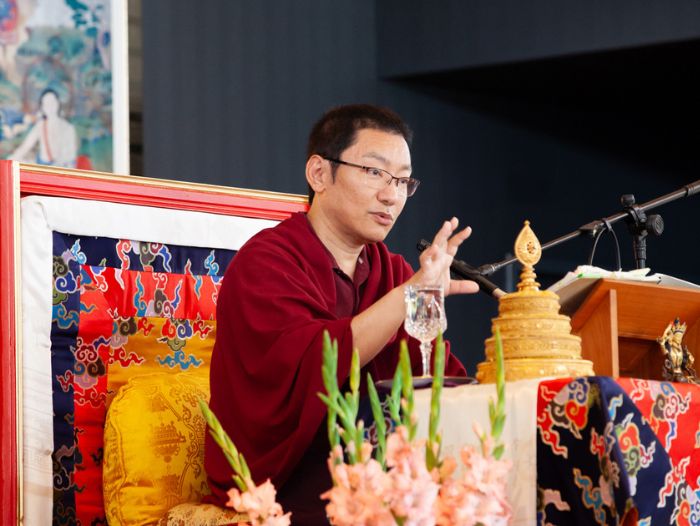
The Madhyamaka school of thought Initial approach
Programe update11/01/2024- According to the school of thought of the middle way (madhyamaka), all phenomena are emptiness and without identity.
Program update 11/01/2024 This text from the III Karmapa, Rangjung Dorjé (1284 - 1339), distinguishes the way knowledge oriented towards objects manifests and operates and primordial wisdom.
On the request of the Tibetan King Mutig Tsenpo, son of King Trisong Detsen, the great 8th-century Indian pandita Kamalashila composed The Steps of Meditation (Bhavanakrama). The first of the three parts describes the steps of familiarization with mental calm, then higher vision, and lastly the paths and the grounds in
In this work, Sakya Pandita Künga Gyaltsen (1182–1251), one of the founding fathers of the Sakya lineage and an eminent teacher respected by all of the traditions of Tibetan Buddhism presents the three disciplines (dom sum) that support Buddhist practice: the disciplines of individual liberation, of a bodhisattva, and of the vajrayana. This text explains […]
Thaye Dorje, His Holiness the 17th Gyalwa Karmapa explains the importance of the Five Royal Sutras that make up the paths of practice. Among them, the Sutra of Aspirations for Excellent Conduct, also known as Samantabadhra’s Wishing Prayer, represents the path of aspiration. The bodhisattva Samantabhadra’s wishing prayers are a model for all to follow. […]
Program update on 03/01/2025 This text from the III Karmapa, Rangjung Dorjé (1284 - 1339), distinguishes the way knowledge oriented towards objects manifests and operates and primordial wisdom.
Program updated on 01/03/2025 – The course initially scheduled from May 7 to 11 will take place in the summer. Thaye Dorje, His Holiness the 17th Gyalwa Karmapa explains the importance of the Five Royal Sutras that make up the paths of practice.
Thaye Dorje, His Holiness the 17th Gyalwa Karmapa explains the importance of the Five Royal Sutras that make up the paths of practice. Among them, the Sutra of Aspirations for Excellent Conduct, also known as Samantabadhra’s Wishing Prayer, represents the path of aspiration. The bodhisattva Samantabhadra’s wishing prayers are a model for all to follow. […]
À la requête du roi du Tibet Mutig Tsenpo, fils du roi Trisong Detsen, Kamalashila, grand pandit indien du VIIIe siècle, a composé les Étapes de la méditation (Bhavanakrama). La première des trois parties décrit de manière détaillée les étapes de la familiarisation avec la quiétude mentale, puis avec la vision supérieure, et enfin les chemins et les terres.
In this work, Sakya Pandita Künga Gyaltsen (1182–1251), one of the founding fathers of the Sakya lineage and an eminent teacher respected by all of the traditions of Tibetan Buddhism presents the three disciplines (dom sum) that support Buddhist practice: the disciplines of individual liberation, of a bodhisattva, and of the vajrayana. This text explains […]
His Eminence Trungram Gyatrül Rinpoche will confer the Milarepa empowerment. In this year celebrating fifty years of Dhagpo’s development and the Karmapa’s activity in the West, Gyatrül Rinpoche, at the invitation of Lama Jigme Rinpoche, honors us by sharing the fruit of his knowledge rooted in practice. It is a new opportunity to discover our lineage, draw inspiration from what has been accomplished, and pay tribute to the masters who made it possible.
Thaye Dorje, His Holiness the 17th Gyalwa Karmapa explains the importance of the Five Royal Sutras that make up the paths of practice. Among them, the Sutra of Aspirations for Excellent Conduct, also known as Samantabadhra’s Wishing Prayer, represents the path of aspiration. The bodhisattva Samantabhadra’s wishing prayers are a model for all to follow. […]
Pour améliorer votre expérience, nous utilisons des cookies et technologies similaires afin de mesurer l’audience du site et de proposer certains services (comme l’abonnement à la newsletter). Vous pouvez accepter, refuser ou personnaliser votre choix à tout moment.