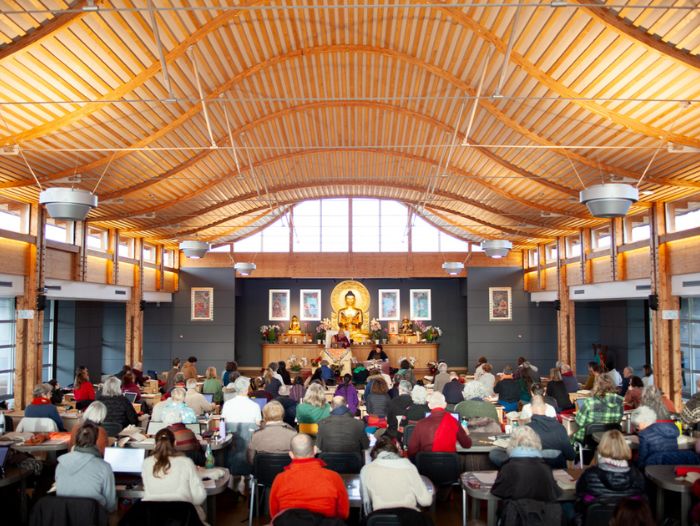
The study of the fundamental texts of Buddhist philosophy is a central focus of life at Dhagpo Kagyu Ling. For the past ten years, an intensive one-month study retreat has been organized in January to allow residents and practitioners from the surrounding area to concentrate on the study of a specific text. Thanks to Lama Jigme Rinpoche, these texts are taught by khenpos and acharyas from shedras in India.
In January 2026, Khenpo Samdrup, from Dzongsar Shedra, continued his explanations of the Gyü Lama for the second year. This text, titled Treatise on the Supreme Continuum of the Great Vehicle in English, was composed by Maitreya and Asanga.
We met with him to discuss his background and his perspectives on teaching the Dharma in Asia and the West.
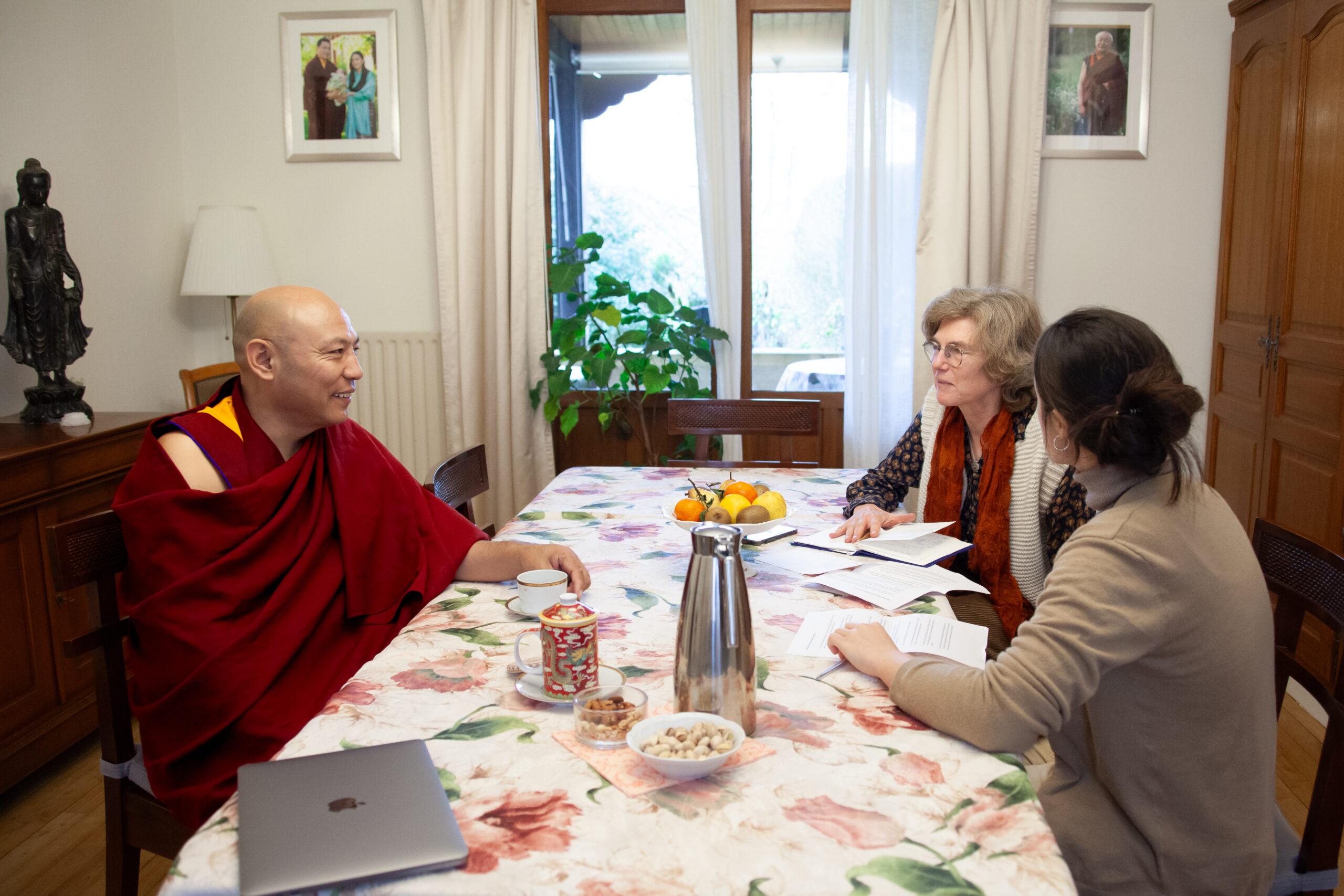 You came to Dhagpo Kagyu Ling for the first time in 2019 and for the past two years you have been teaching the Gyü Lama for three weeks during the winter study retreat. You come from the shedra of Dzongsar Khyentse Chökyi Lodrö in Chauntra, near Dharamsala (India), belonging to the Rimé tradition. What is your connection to Dhagpo and how did you meet Jigme Rinpoche?
I met Jigme Rinpoche for the first time here at Dhagpo Kagyu Ling. But the connection goes back much further.
In fact, the 16th Karmapa and the previous incarnation of Shabdrung Rinpoche were from the same family, the Athub family, so it’s a deep connection. The monastery I come from in Tibet received a lot of help from Karmapa and Künzig Shamar Rinpoche. I come from the same region in Tibet as the present incarnation of Shabdrung Rinpoche, Dongsung Shabdrung Rinpoche, whose monastery is near Yushu, in the Nangchen region. He suggested that I come here, I was invited, and I met Jigme Rinpoche on that occasion. Since then, the bond has continued to deepen.
I came to teach several times for shorter stays, then Jigme Rinpoche told me that there would be a need to teach the Gyü Lama.
 When did you study the Gyü Lama? How did you approach it here?
It is studied in the tenth year of shedra, and I have taught it twice to its students. To prepare for this teaching,
I discussed with Jigme Rinpoche the approach to follow. I thought I would approach it by explaining the meaning and being fairly brief, as it is common among teachers to approach teachings for Westerners in this way. But Jigme Rinpoche said that, on the contrary, the idea was to go into detail, word by word, and that it would take as long as necessary. He said that it was really necessary to explain what was in the text in order to understand everything in detail, and so that students could repeat the Gyü Lama in the future.
For this, the translator had to understand the content, so I prepared a support that could also be useful for those who speak and read Tibetan. So it is a study aid that applies Rinpoche’s instructions. Given that the goal is for the Dharma to take root and remain in the West for a long time, writing this document is a very small task, a drop in the ocean, but I hope it will be helpful.
Is there a difference between the way you teach at the shedra and here at Dhagpo or elsewhere in Europe?
It’s a little different, but given the instructions given by Jigme Rinpoche, it’s quite similar.
The difference is mainly in the way we teach younger students at the shedra, where we go through the texts word by word. In the higher classes, we study these texts in a more comprehensive way, looking at the sentences as a whole, what they mean, the doubts they clarify, and comparisons between texts. The students already know the texts, since they studied them when they were younger.
In reality, I don’t think there is much difference between teaching Westerners and Asians, because the goal of the teaching is for people to transform their minds and progress on the path. From the moment you start studying, you can see that this is the goal and that the teaching simply provides the tools to achieve it.
You became a monk at the age of eleven. How did that change you?
I come from a family of practitioners. In general, in Tibet, people have a lot of respect and devotion for monastic commitment. I didn’t become a monk because of difficulties I had when I was little, or because I renounced the world after seeing the faults of samsara. Rather, it was because I wanted to, because my friends had done the same, and because it also inspired my family. Moreover, from a very young age, I never really aspired to a secular life. I wanted a monastic life and I devoted my life to it.
When I was in Tibet, people praised study conditions in India, the fact that you were provided with food and lodging and could therefore just devote yourself to your studies. In Tibet, it took two or three days on horseback to reach Dzongsar Monastery. You had to carry your own food, cook, know how to store it, etc. It was more complicated to study under these conditions. Nevertheless, before going to India, I studied Tibetan grammar and civilization. Before you can study Buddhist texts directly, you need to have a good knowledge of grammar treatises and poetry. This traditional progression then allows you to access the Dharma texts.
From 2000 on, I started off by teaching Tibetan grammar at the Dzongsar Shedra in India.
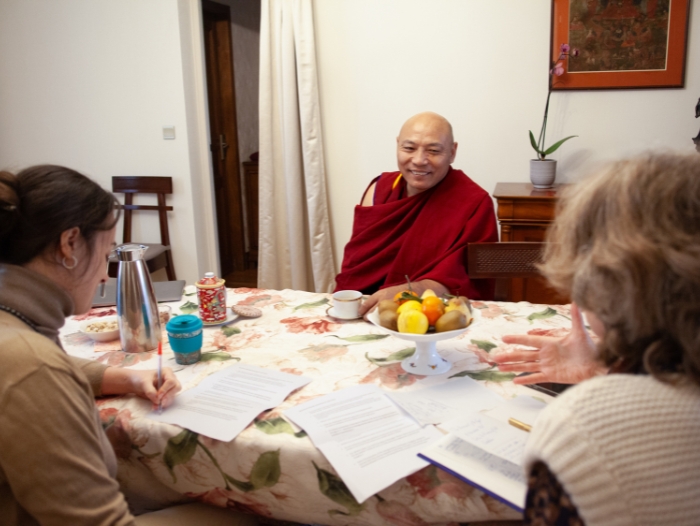 You headed the Dzongsar Shedra. What were your priorities? And is the teaching of students who aspire to become khenpo evolving, taking into account the fact that some will be called upon to teach abroad?
There are many responsibilities, but above all, we must take care of the monks’ studies as best we can. They begin around the age of fifteen. We do not emphasize the fact that some will be called upon to teach abroad.
Nor do we give instructions on teaching Westerners, but rather we receive advice, for example from Dzongsar Khyentse Rinpoche. Of course, some go to Taiwan, others here to Europe, but this is not emphasized in our programs. The shedra does not send people abroad; it is more a matter of the monks’ own contacts or networks, and their personal predispositions.
Do you alternate between periods of study and retreat?
My responsibilities as principal of the shedra did not leave me much time. Now I have more free time and I would like to spend more time in retreat. Speaking of free time, I believe that the question of whether or not we have time really depends entirely on us.
Ultimately, it is always up to us to decide what we do with our time.
Have you noticed a change in the vocation of becoming a khenpo?
There are slightly fewer people interested in this field or completing their studies, but nonetheless, eighteen monks received their khenpo certificate during the Dzongsar Mönlams in Bodhgaya this winter.
There is already preparation before entering the shedra, then eleven years of study, at the end of which one receives the title of chöpön. After teaching for several years, one can receive the khenpo diploma. But it is also possible that after ten years of study, a student may be called back to his or her home monastery to teach; he or she may nevertheless become a khenpo later on.
What about nuns?
At Dzongsar, we don’t have many anila who have become khenmo[1] —it should be noted that it is preferable for monks and nuns not to be in the same place—but there are many in Tibetan society.
There are specific places for nuns aspiring to become khenmos, such as the shedra in Dheradun, a few hours from Dzongsar, and another Nyingma shedra, Namdroling, in southern India. Among the Gelugpas, there are also many geshemas[2].
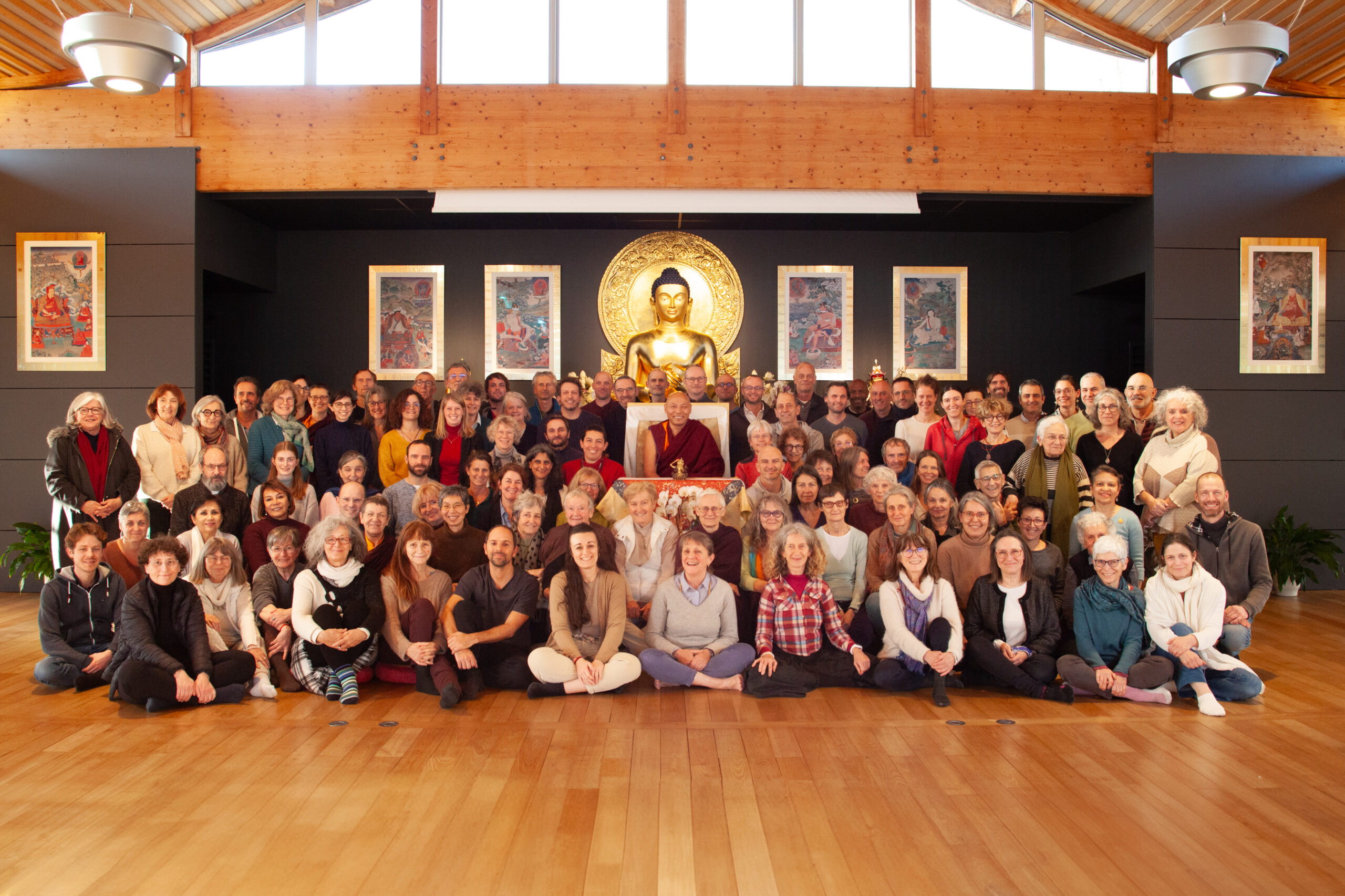 Jigme Rinpoche encourages the Institute’s students to repeat the texts they receive with each other, some of which serve as the basis for public teachings. How does teaching enrich your own practice?
I see immense benefit, both from the point of view of my practice and from the point of view of my studies. When I hear the Dharma, I understand it better and better. Moreover, since I have to teach the students, it pushes me to go further in my personal understanding.
Do you have any advice on good methods for studying?
The method followed here—receiving the teaching, studying together, and sharing—is a very good method. However, I think it is difficult to know all the Dharma texts. In secular life, we study to get a job and make a living.
In the context of the Dharma, the goal is to free ourselves from samsara and attain the full and perfect enlightenment of the Buddha. To achieve this, we need to gather a large number of causes and conditions, and this requires studying the various texts. It is vast and time-consuming, but it is good to have as complete a study of the texts as possible. There are particularly important texts such as the Abhidharma, because without understanding the worlds of form and formlessness, the different samadhis, etc., it will be difficult to know the goal. The Gyü Lama is also very important in terms of the logic of causes, conditions, and consequences that it presents. With a single text, one cannot understand everything. In the Gyü Lama, there is much reference to emptiness, but to understand this, one must study Madhyamaka!
The main difference with the shedra is that here and elsewhere we are caught up in other things, and this delays our understanding of the text. What is important is consistency, attending all sessions, otherwise one will not reap the fruits of study. Time depends on us. If we give priority to study, we will be able to make time for it. For it is only in the state of buddhahood that there is no longer any need to study!
[1] Khenmo is the equivalent of khenpo for nuns/female monastics.
[2] Equivalent to khenpo inthe Gelugpa school.
A few archival images
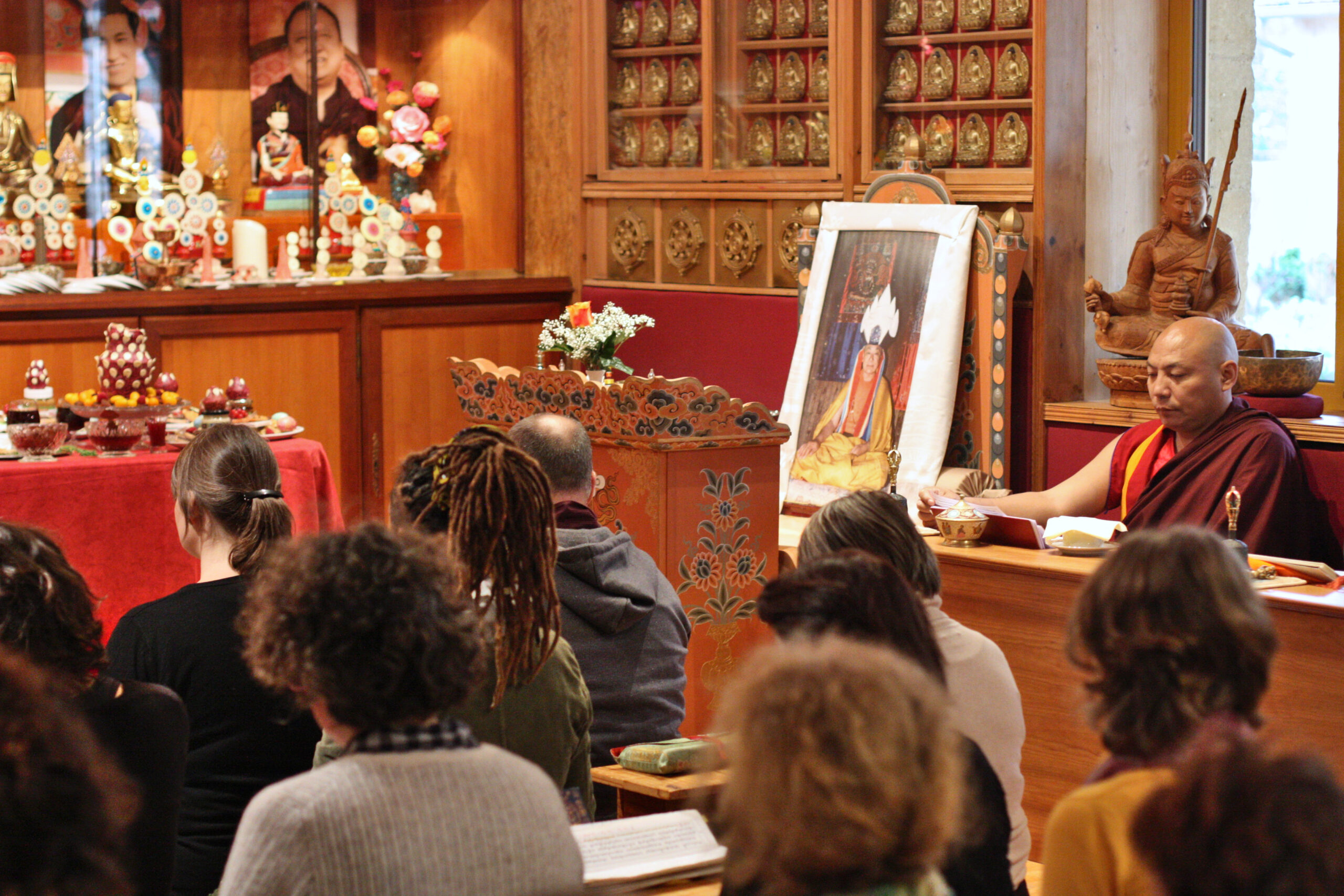
February 2019 – at the Temple of Dhagpo Kagyu Ling
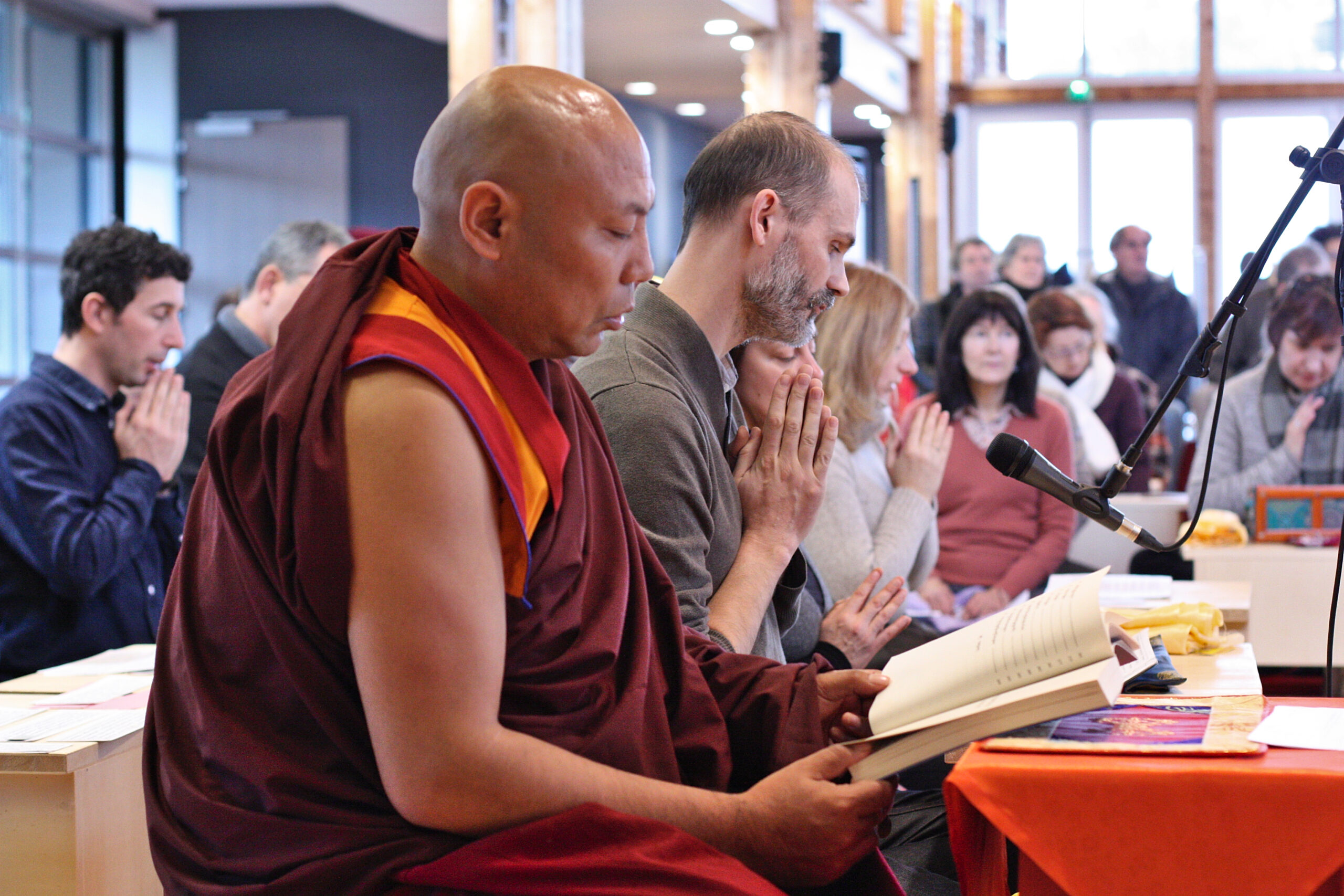
February 2019 – Khenpo Samdrup at the Dhagpo Kagyu Ling Institute
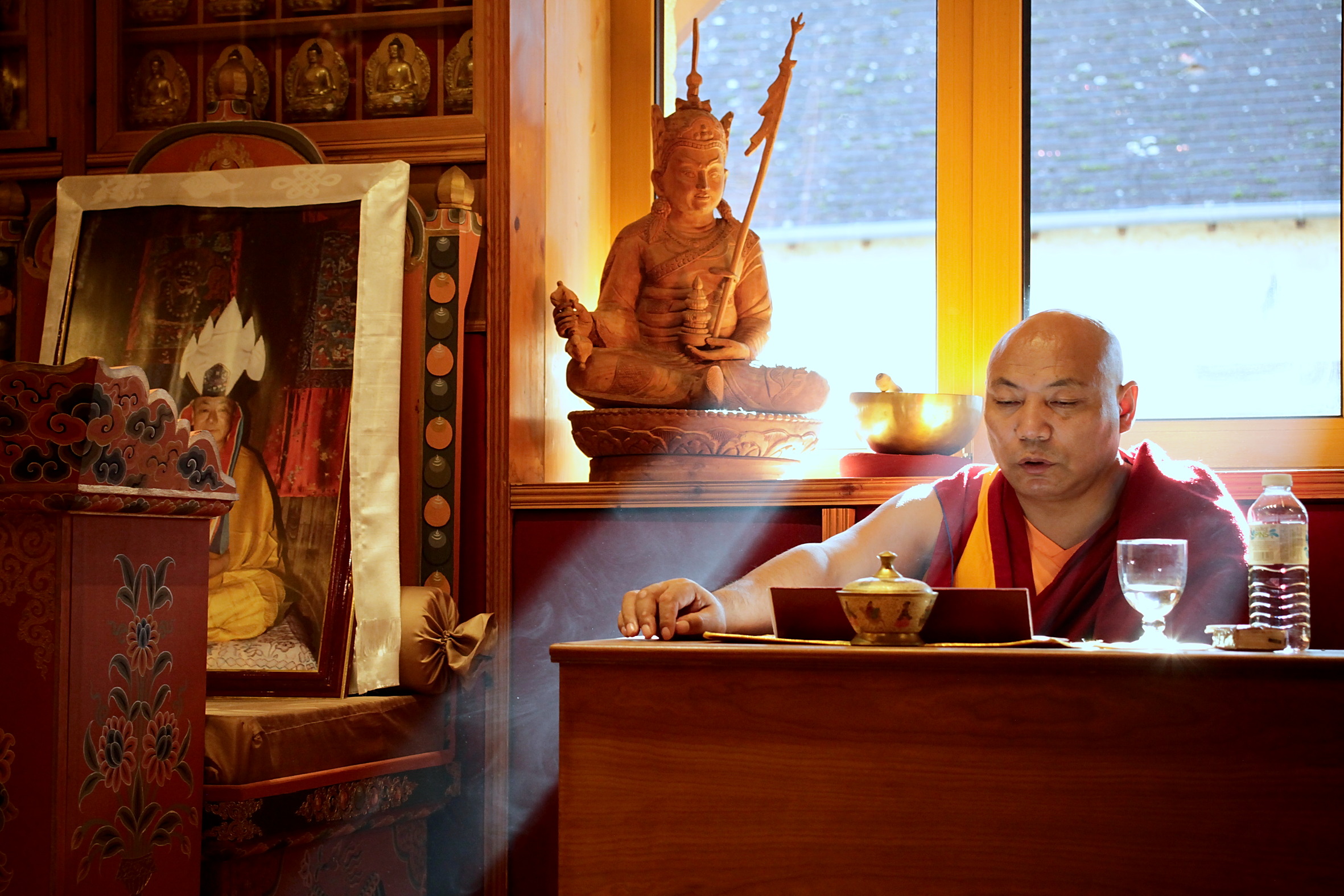
February 2020 – at the Temple of Dhagpo Kagyu Ling
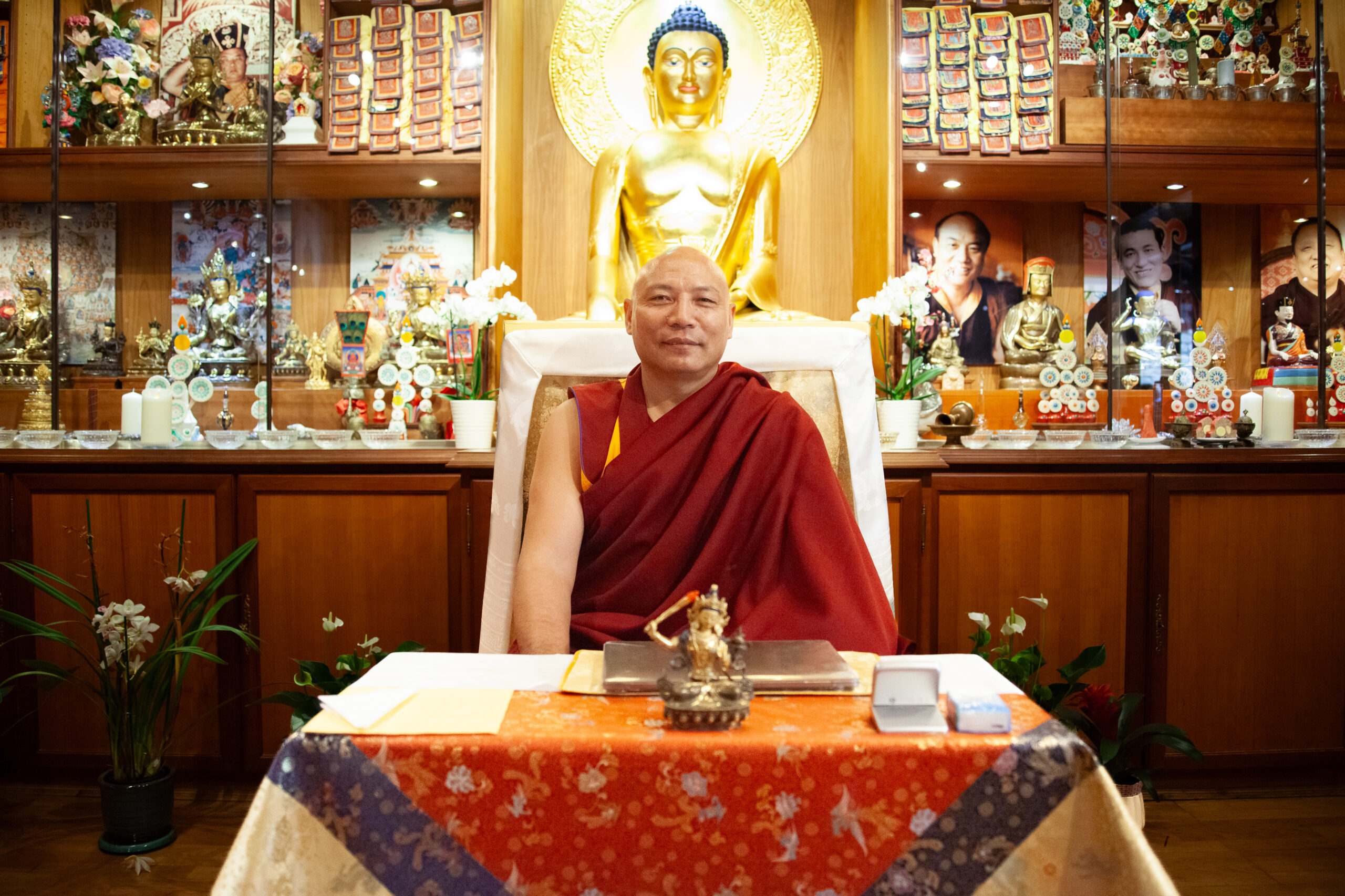
February 2024 – at the Temple of Dhagpo Kagyu Ling