What is the heart of Dharma?”
What is the heart of this practice that we wish to undertake?”
Developing love and compassion.”
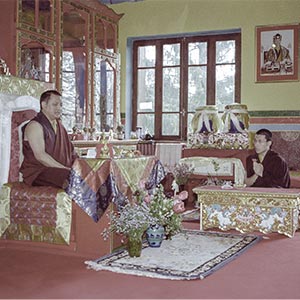
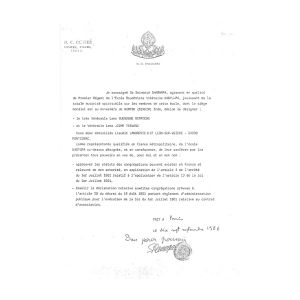
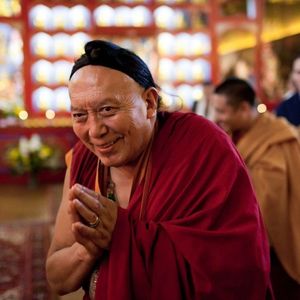
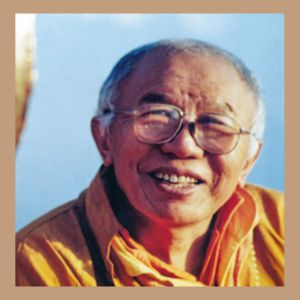
 A dream, a photo, a friendly piece of advice, open doors, an announcement for a conference, a quest for meaning…many different paths steered several generations of individuals toward Lama Gendun Rinpoche. Most often, an inner transformation occurs from the first glance, changing the course of a life, as evidenced by a collection of writings on first encounters with this accomplished meditation master [1]. In a short prayer to Lama Gendun Rinpoche, composed at the request of Western disciples in October 1984, Künzig Shamarpa writes,
“The rivers of his compassion flow over predisposed living beings.”
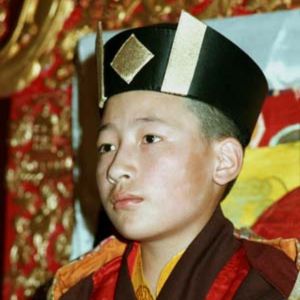
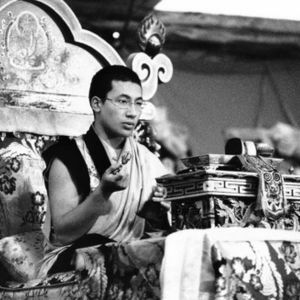
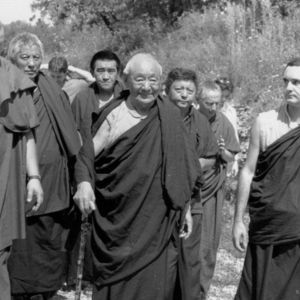
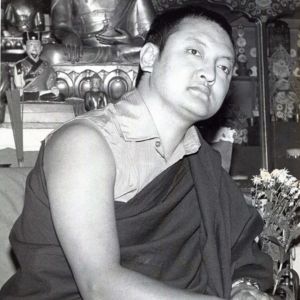
On October 31, 1997, this precious master, “jewel of the community,” entered parinirvana in his room at Dhagpo Kundreul Ling, after twenty-two years of tirelessly transmitting the pure and authentic Dharma to Westerners, fulfilling the instructions of his root master, the 16th Gyalwa Karmapa Rangjung Rigpe Dorje, whom he had met at the age of thirteen, when the Karmapa was still a young child.
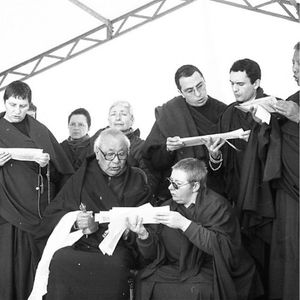
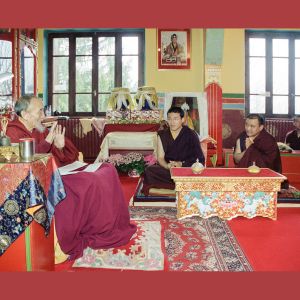
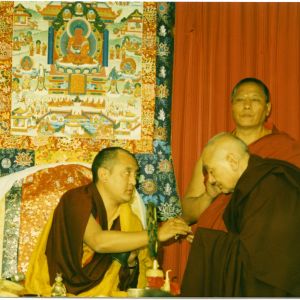
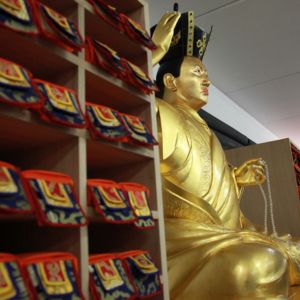
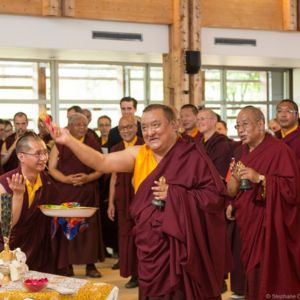
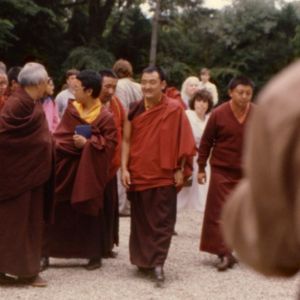
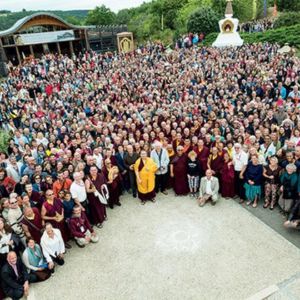
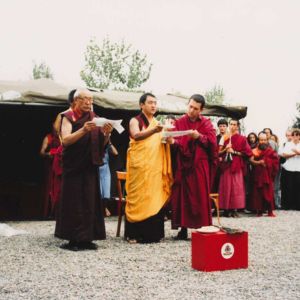
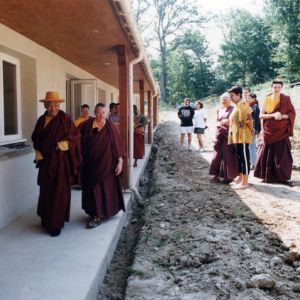
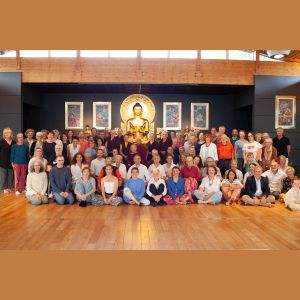
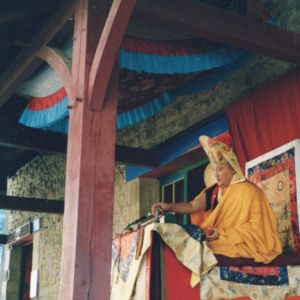
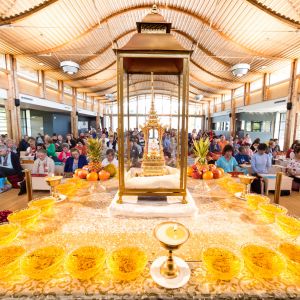
Less than ten days before, on October 22, 1997, Rinpoche participated in the coming out ceremonies of the fourth traditional three-year retreat in the not-yet-completed Great Temple. The thousand buddhas had just been placed in their alcoves. He blessed the 104 men and women who participated in the retreat and close to one thousand practitioners who came for the occasion, including the lamas and druplas who had previously accomplished retreats under his direction.
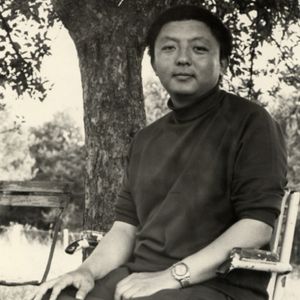
From childhood, Gendun Rinpoche experienced a deep aspiration for spirituality. In accordance with his wishes, he entered a monastery at seven years old, learned to meditate with great masters, received major monastic ordination at seventeen, and carried out the traditional three-year retreat at twenty-one years old. Following his retreat, he undertook pilgrimages in the holy places of Tibet and Nepal and spent close to thirty years in solitary retreat in Tibet, then Bhutan and India, following a perilous escape from his home country in 1959.
One evening, the 16th Karmapa, following his first trip to the West, invited Lama Gendun Rinpoche to the terrace of his residence in Rumtek, Sikkim.
In an interview with Lama Tsony, recorded in May 1994, Lama Gendun Rinpoche shares the instructions he received from the 16th Karmapa during that meeting, instructions that changed the course of his life.[2]
You must go to the West now. There, you should give blessings, empowerments, and Dharma teachings. Once in Europe, you should build a temple, a monastery, and a retreat center, and you should teach the Dharma. You must not limit yourself to a single country but rather spread the Dharma everywhere. Thus, many people may connect to Buddhism and develop trust in it. The time is ripe, and it is necessary to act at the right moment. Individuals have strong emotions, and the situation can change rapidly. We are giving people the opportunity to understand their emotions, to distinguish between positive and negative, allowing them to act in a beneficial way. [..] It is extremely important to accomplish the benefit of beings and bring the Dharma everywhere. If we succeed, suffering will be minimized.
Lama Gendun Rinpoche recalled that he was speechless. “Why me? I am an old man, and the Karmapa gave me so many responsibilities. I couldn’t imagine how it would be possible.” Karmapa read his thoughts,
The time is ripe and you have the right karma. You could accomplish everything. Trust me. I am Karmapa.
His Holiness blessed him and conferred upon him all of the transmission and blessing of the lineage, making him a holder of this lineage. “It still brings tears to my eyes today,” said Rinpoche.
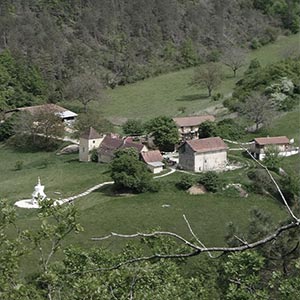
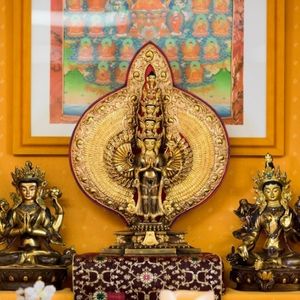
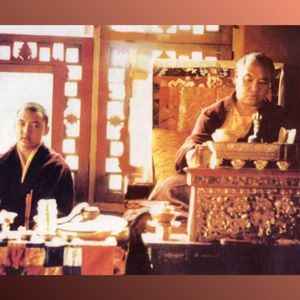
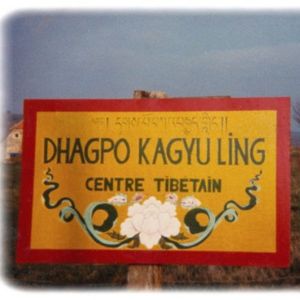
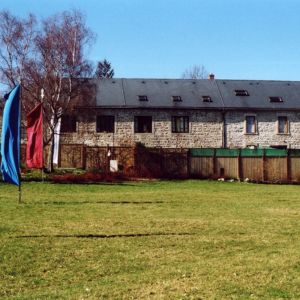
 Thus, one day in August 1975, Lama Gendun Rinpoche, then fifty-seven years old, arrived at the dilapidated farm Landrevie accompanied by Lama Purtse. Lama Jigme Rinpoche had been there since May of 1975. Lama Gendun Rinpoche began to teach—the preliminary practices of Mahamudra; Chenrezig and Amitabha practice, the seven-branch prayer, the paramitas, Gampopa’s Precious Garland of the Supreme Path, and more.
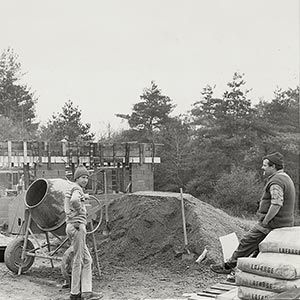
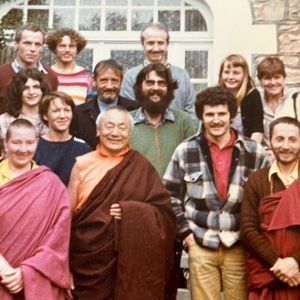
Little by little people came, stayed, learned, practiced, and began to renovate and build. In 1980, Gendun Rinpoche also began traveling with Lama Jigme Rinpoche to various cities in France, supporting disciples’ interest in establishing urban centers (KTT), where he continued to teach frequently over the years. He also traveled to various European countries, including Germany, the Netherlands, Greece, Italy, Austria, Belgium, and England. At Dhagpo Kagyu Ling, he prepared his disciples for the three-year retreat, giving teachings and empowerments, with a focus on training teachers who could in turn teach the precious Dharma.
As he grew older, he became concerned about the difficulties of establishing retreat centers, until an opportunity arose in the fall of 1983: the sale, in the town of Biollet, of a property belonging to the author and filmmaker Arnaud Desjardins, whose work had significantly contributed to bringing the wisdom of Tibetan masters to the general public.
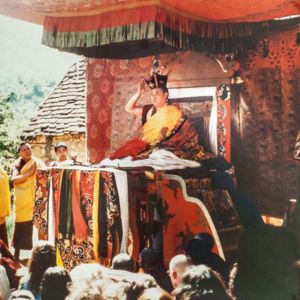
The place had strong spiritual roots, having already been a center for teaching and meditation founded by Desjardins. The 16th Karmapa had twice given the black crown ceremony there, and Dilgo Khyentse Rinpoche and Dudjom Rinpoche had also stayed there.
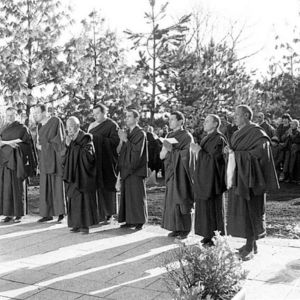
The future retreatants quickly set to work preparing the building, and the first traditional retreat of three years, three months, and three days began on March 17, 1984 with fifteen men and five women.
The purpose of this kind of retreat is to enable us to help others and achieve the true goal of our lives, complete enlightenment. […] This retreat is a great help in finding the path to deep meditation, dissolving the egotistical tendencies we have accumulated over eons, and realizing Mahamudra,” explained Lama Gendun. [3]
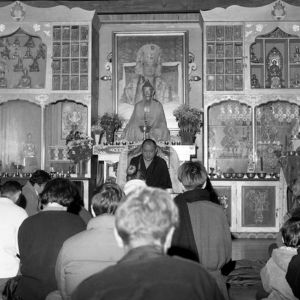
With boundless energy and spiritual generosity, Lama Gendun oversaw this retreat and the two that followed, going to the drupkang almost every day to give teachings, transmissions, and advice—seeming to know precisely what was going on in everyone’s mind. A growing number of practitioners expressed the desire to undertake such a retreat, and on this basis, new retreat centers and monasteries for men and women were built. Lama Gendun thus accompanied nearly three hundred retreatants through this learning of the profound methods of Vajrayana. In 1994, the fourth retreat began, which he entrusted to his close disciples while remaining present at their side.
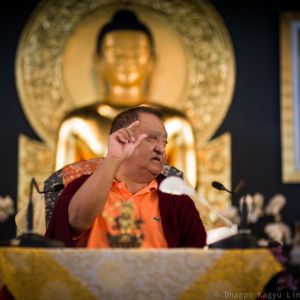
 Nevertheless, he continued to teach at Dhagpo Kagyu Ling several times a year until August 1997, when, over several days, he taught the essential stages of the Buddhist path and shared its essence, giving spiritual advice to both newcomers and his long-time disciples. For example: “The feeling of humility, equality, and compassion towards all beings must be the cornerstone of our path.” This would be his last teaching.
Through his example and realization, Lama Gendun Rinpoche inspired generations of practitioners. Künzig Shamarpa wrote of him:
Lama Gendun of Chödrak is an accomplished sage who has uprooted attachment to gain and honor as well as ambition. The proof of this is that his spiritual qualities have been praised many times by Buddha Karmapa himself. Nowadays, it is extremely rare to find someone like him, capable of giving personalized practice instructions that meet the needs of each disciple. This, together with his ability to truly transform his disciples through his radiance, is proof of his accomplishment.
[4]
At the beginning of the Chenrezig course in October 2018, Jigme Rinpoche used the example of Lama Gendun Rinpoche to explain what it means to remain in the uncontrived state of our mind. Here is what he said:
The 16th Karmapa sent Gendun Rinpoche to Europe. Why? So that Europeans could have an example of what it means to accomplish practice, otherwise it is very easy to get caught up in all sorts of imaginary representations and fantasies about it. By sending Gendun Rinpoche here, Karmapa gave us this example to show us that it is possible for a human being to accomplish practice. He also encouraged us, showing us that if we apply practice, it is possible to develop in his image. We can therefore remain in our ordinary samsaric life but at the same time actualize the result of practice. The Karmapa, in the person of Gendun Rinpoche, gave us an example of the goal that a Dharma practitioner can achieve.
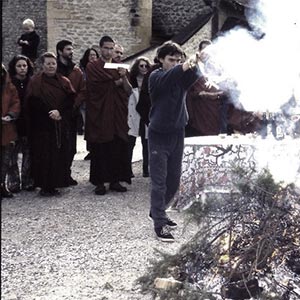
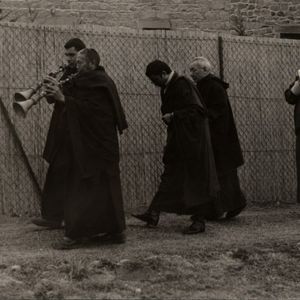
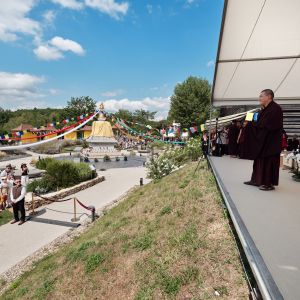
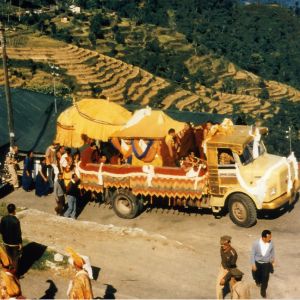
Gendun Rinpoche never returned to India or Tibet. Upon his parinirvana, permission was granted to keep his body at Dhagpo Kundreul Ling and to perform the traditional funeral rituals there for forty-nine days. Then, in an unprecedented move, permission was also granted to cremate him on site and build a funeral stupa, reflecting the exceptional nature of Rinpoche’s presence. Shamar Rinpoche and Jigme Rinpoche performed the practice and jinsek (fire offerings) of Gyalwa Gyamtso, while his Western disciples performed those of Korlo Demchok and Dorje Pamo, allowing everyone to strengthen their connection with him and create the conditions for future blessings.
As Lama Jigme Rinpoche explains:
Beyond sadness, Rinpoche’s departure connects us. It connects us to the lineage, to the masters of the past, and it also connects us to each other. This is how it is in the Kagyu lineage, of which we are the heirs—the lama lets us continue on the path alone because we are ready. […] It is our turn to follow the example set by the lama and to keep him alive by practicing what he has transmitted to us. Our mind and his will then be inseparable.
(Tendrel, no. 45)
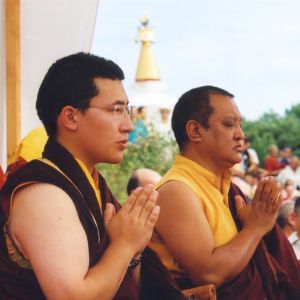
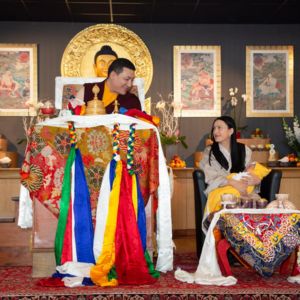
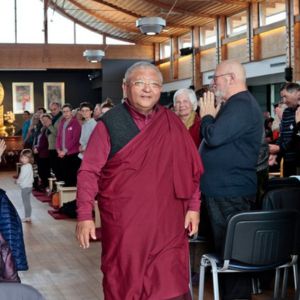
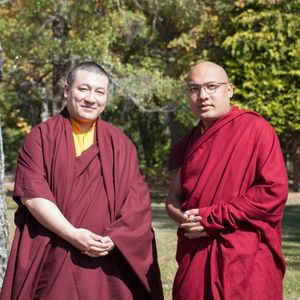
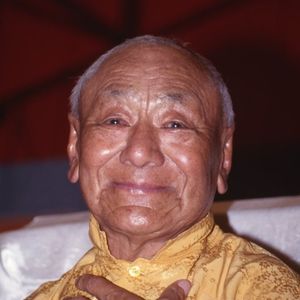
Gendun Rinpoche’s kindness, compassion, simplicity, joy, and laughter—all reflections of his realization—are engraved in the hearts of all practitioners who have had the good fortune to cross his path. Through these qualities, Gendun Rinpoche was able to transmit profound and authentic teachings to many disciples in Europe, without distinction between men and women. The foundations he laid to lead beings to awakening—bringing them understanding and the means to free themselves from suffering—continue to take root, thanks to the activity of the 17th Gyalwa Karmapa Thaye Dorje, Künzig Shamarpa, and Jigme Rinpoche. Künzig Shamarpa recognized his reincarnation in the person of Gendun Rinchen. The journey to encounter the wisdom of the Buddha continues…
[1] Premières rencontres. Autour de Guendune Rinpoché. Publication KTL, October 2017.
[2] Gendun Rinpoche. A Buddhist Master Remembers. Vienna Dharma Projects, 2022.
[3] Gendun Rinpoche. Heart Advice from a Mahamudra Master. Norbu Editions, 2010
[4] Colophon of the prayer to Lama Gendun, composed by Künzig Shamar Rinpoche.


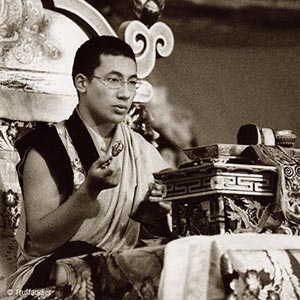
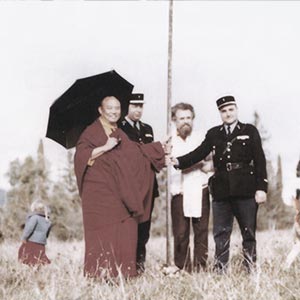
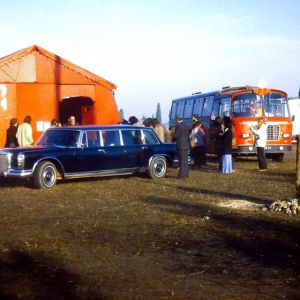
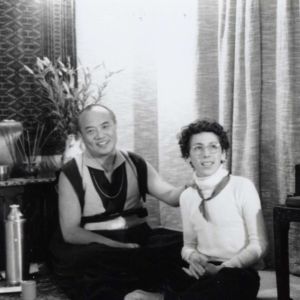
These photos come from our archives or were collected as part of the research for Dhagpo Kagyu Ling’s 50th anniversary. We have not been able to identify all the authors. The use of these photos is solely for informational purposes within the context of Dhagpo Kagyu Ling’s 50th anniversary celebration. Their use is limited to this event and our website and is not for commercial purposes.
Event
To commemorate this event, on Friday, 31 October at the Dhagpo Kagyu Ling Institute, various practices and teachings of Gendun Rinpoche will take place.


These photos come from our archives or were collected as part of the research for Dhagpo Kagyu Ling’s 50th anniversary. We have not been able to identify all the authors. The use of these photos is solely for informational purposes within the context of Dhagpo Kagyu Ling’s 50th anniversary celebration. Their use is limited to this event and our website and is not for commercial purposes.