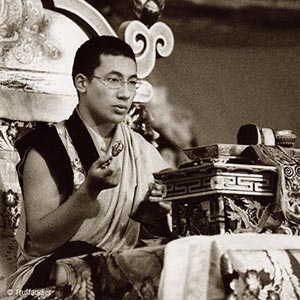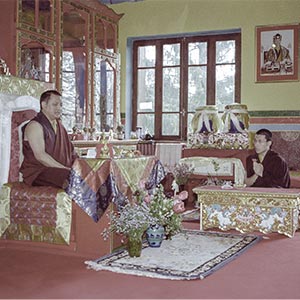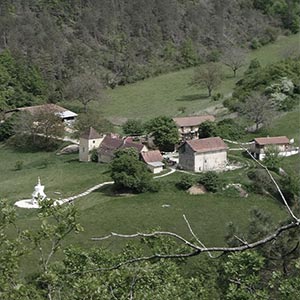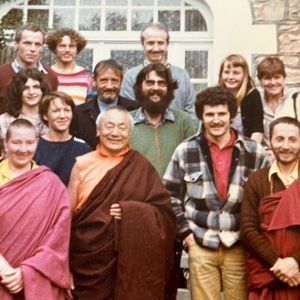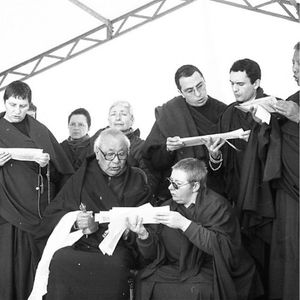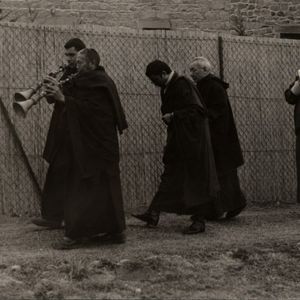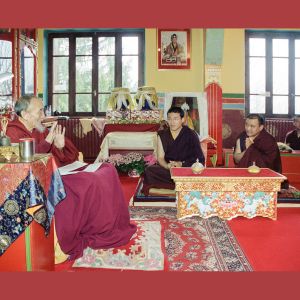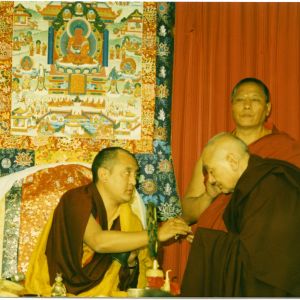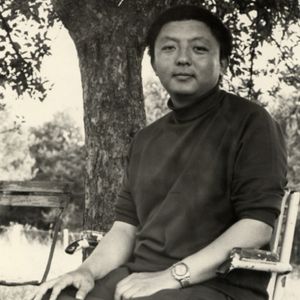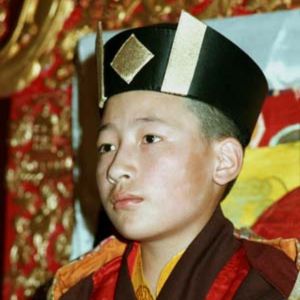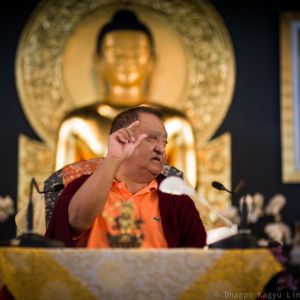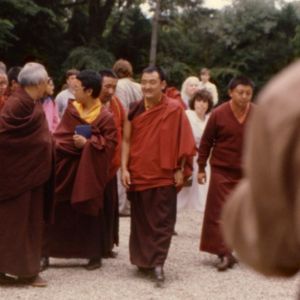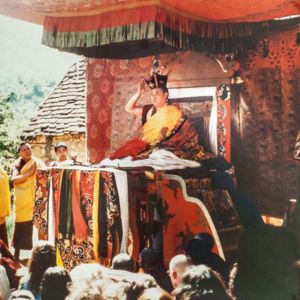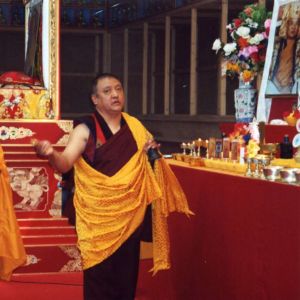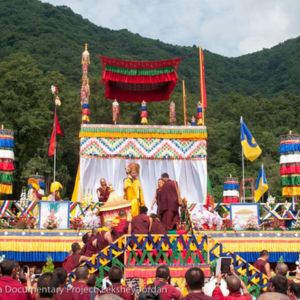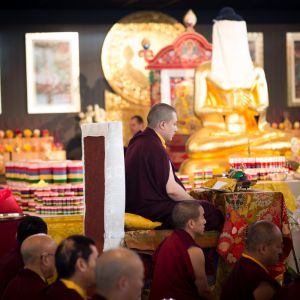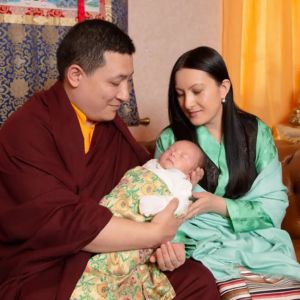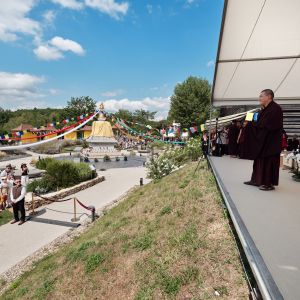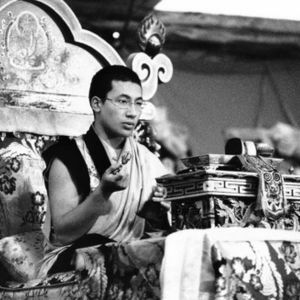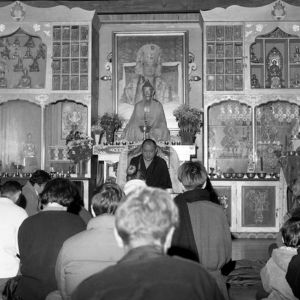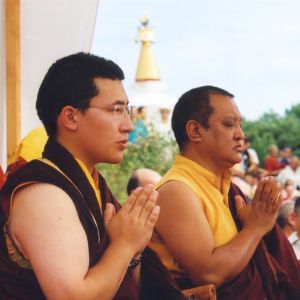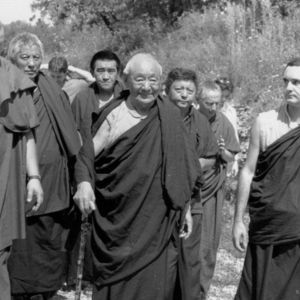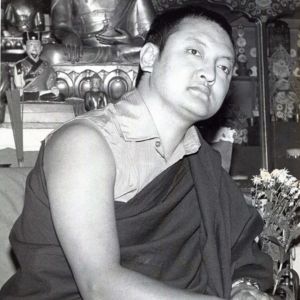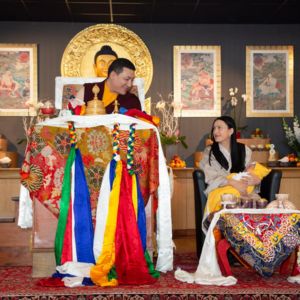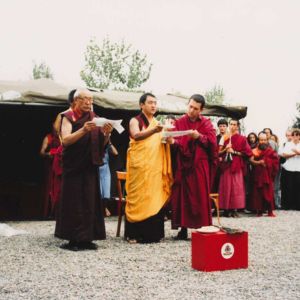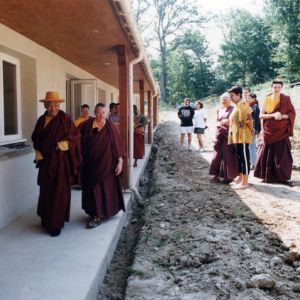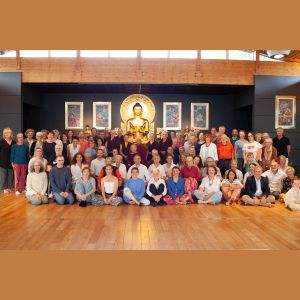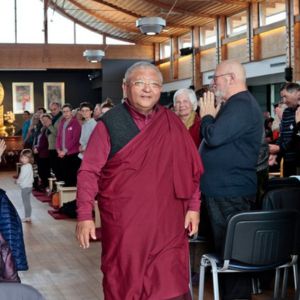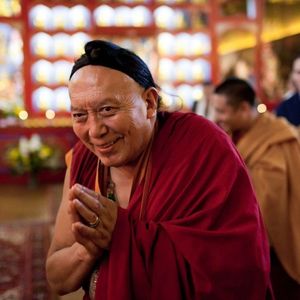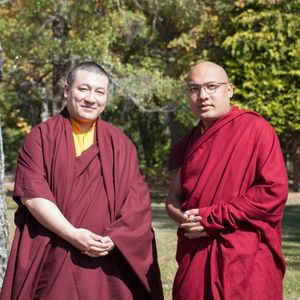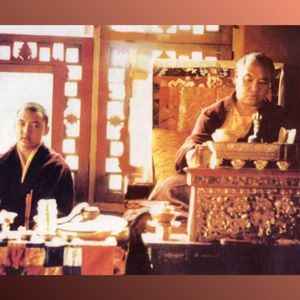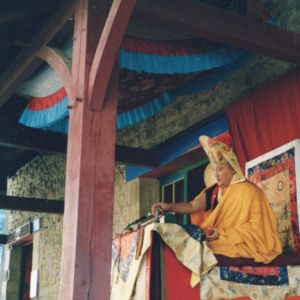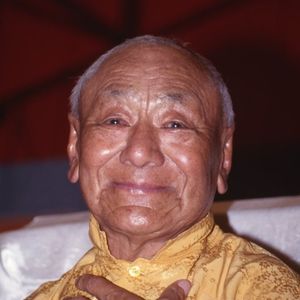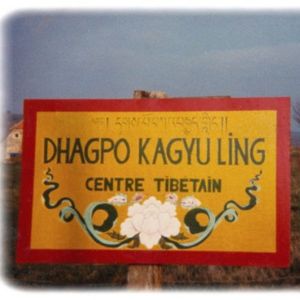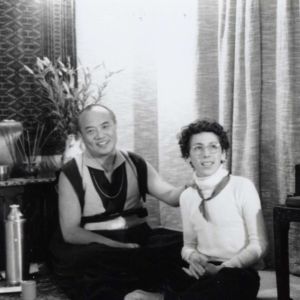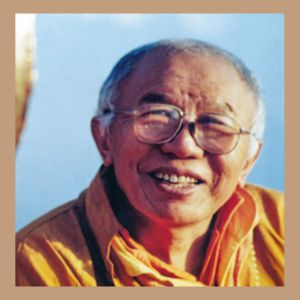
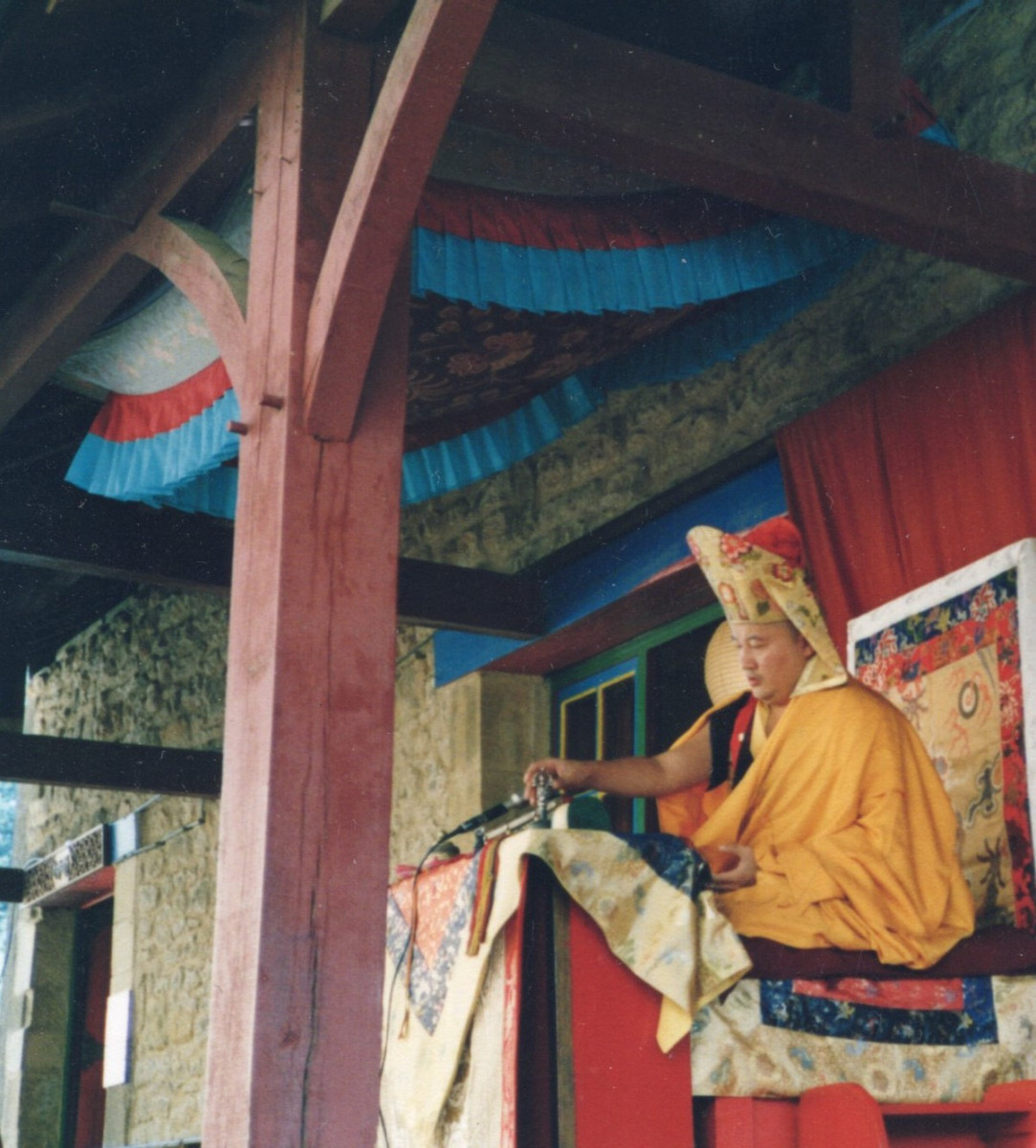
His Eminence Gyaltsab Rinpoche, an eminent lama of the Karma Kagyu lineage, visited Dhagpo Kagyu Ling for the first time in late October 1982 to teach, confer empowerments, and lead ceremonies to commemorate the first parinirvana of the 16th Gyalwa Karmapa, Rangjung Rigpe Dorje.
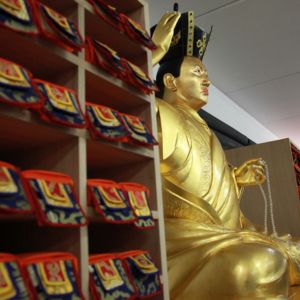
Recognized by the 16th Gyalwa Karmapa even before his birth, Gyaltsab Rinpoche, born in 1954, fled with the latter in 1959 and received his education at Rumtek Monastery in Sikkim. He is the twelfth incarnation of a lineage dating back to Gyaltsab Rinpoche Paljor Dondrub (1427-1489), born in Nyemo Yakteng, Tibet. The latter received the title of goshir—state teacher—from the Emperor of China himself. In the 7th century, he appeared as the skilled minister of the great Tibetan king Songtsen Gampo. Later, he was Shiwa Eu, one of the eight renowned disciples of Milarepa. He is said to embody the activity of the bodhisattva Vajrapani, the one who holds the vajra in his hand, specially charged with the transmission of tantras among human beings.
It is therefore during All Souls weekend at the end of October 1982 that Gyaltsab Rinpoche taught about the Wheel of Life, or Wheel of Existence (Sanskrit: bhavachakra, Tibetan : srid pa’i ‘khor-lo), a pictorial representation of samsara, commonly found at the entrance to Tibetan monasteries. It depicts the cycle of existence by means of several concentric circles trapped in the claws of a monster symbolizing Yama, death or impermanence. In the center are three animals chasing each other’s tails (a pig, a snake and a rooster), symbols of the three poisons (ignorance, anger, and desire) that are the source of suffering in samsara. The next two circles illustrate the force of positive and negative karma and the six realms. The outer rim represents the twelve links of dependent origination. On the outside, the Buddha shows an eight-spoked wheel, symbolizing the eightfold path that liberates from the chains of samsara.[1]
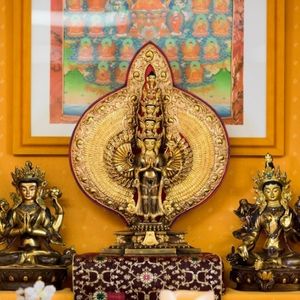
During this stay, Rinpoche also taught Gampopa’s four Dharmas[2] and the practice of Dorje Purba, conferring the empowerment of this yidam as well as that of Vajrapani.
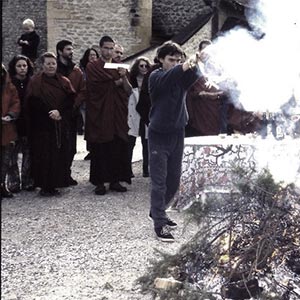
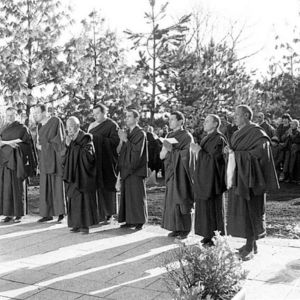
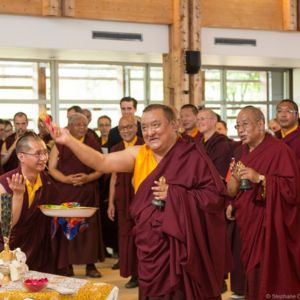
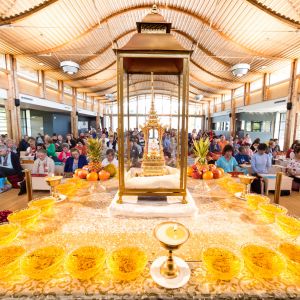
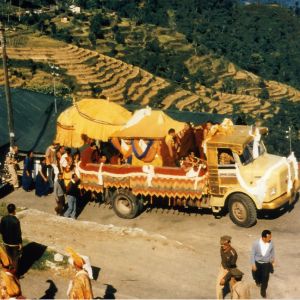
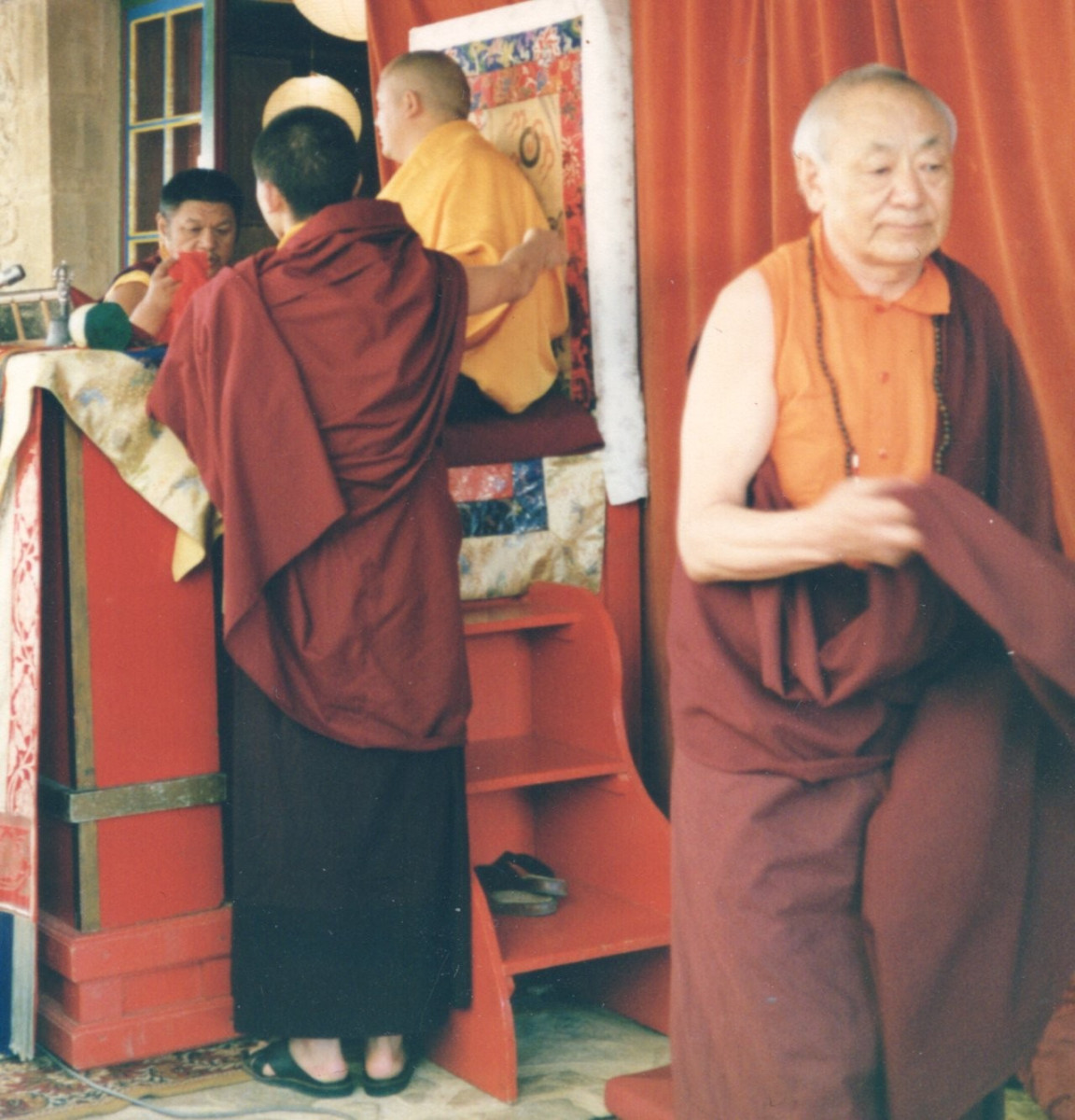
On November 7, while in Rumtek the relics left by the 16th Karmapa were placed in the two stupas built for this purpose, in Dhagpo, on this day of düchen, Gyaltsab Rinpoche led offering ceremonies, accompanied by Khenpo Jam Yang Dorje (of the Nyingmapa school), Gendun Rinpoche, Lama Purtse, and Lama Zimpön.
On the same day, Gyaltsab Rinpoche ordained four novice monks (getsül) and one nun (getsülma). This was the first ordination ceremony since the passing of the 16th Karmapa, an occasion to perpetuate the Vinaya tradition (a collection of the Buddha’s words on discipline for monastic and lay practitioners) in the West. Rinpoche also granted the empowerment of Buddha Maitreya, the fifth of the thousand Buddhas of our era.
In August 1989, His Eminence Gyaltsab Rinpoche returned to Dhagpo to confer, every afternoon for ten days, empowerments from the Chik Shé Kundröl cycle compiled by the 3rd Karmapa, which brings together short practices of the peaceful and wrathful aspects of the tantric path. The 3rd Jamgon Kongtrul Rinpoche stated at the time that receiving this cycle of empowerment from His Eminence was like receiving them from Vajrapani himself, since he is the emanation of the guardian of the tantras. Rinpoche then gave five days of teachings based on the Treasury of Knowledge by the 1st Jamgon Kongtrul Lodrö Thaye, dealing with the progressive path (lam rim) and progressive meditation (gom rim).
[1] Cornu, Philippe. Dictionnaire encyclopédique du Bouddhisme. Nouvelle édition augmentée. Éditions du Seuil, May 2001
[2] “Grant your blessings so my mind may turn toward the Dharma.
Grant your blessings that Dharma may become the path.
Grant your blessings that the path may dispel confusion.
Grant your blessings so that confusion may dawn as wisdom.”
These photos come from our archives or were collected as part of the research for Dhagpo Kagyu Ling’s 50th anniversary. We have not been able to identify all the authors. The use of these photos is solely for informational purposes within the context of Dhagpo Kagyu Ling’s 50th anniversary celebration. Their use is limited to this event and our website and is not for commercial purposes.


These photos come from our archives or were collected as part of the research for Dhagpo Kagyu Ling’s 50th anniversary. We have not been able to identify all the authors. The use of these photos is solely for informational purposes within the context of Dhagpo Kagyu Ling’s 50th anniversary celebration. Their use is limited to this event and our website and is not for commercial purposes.