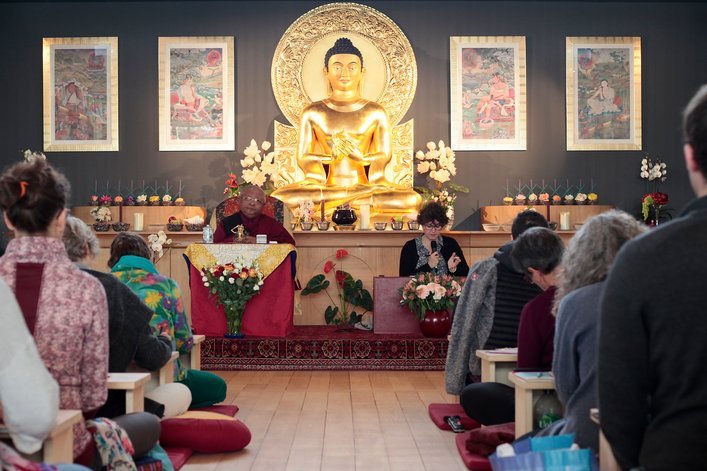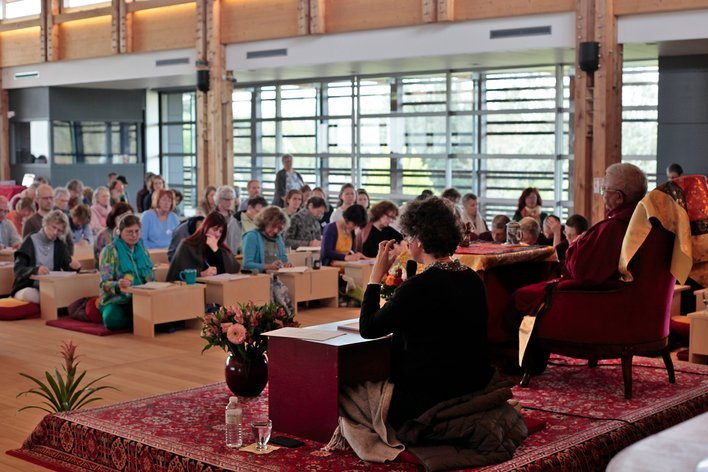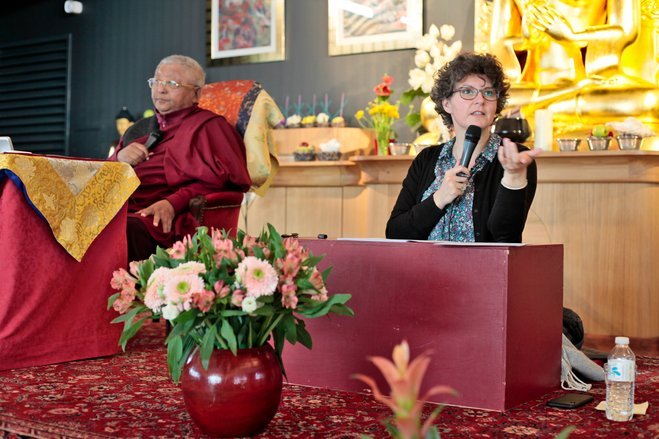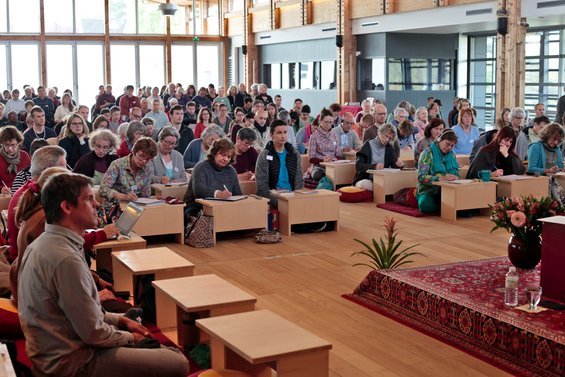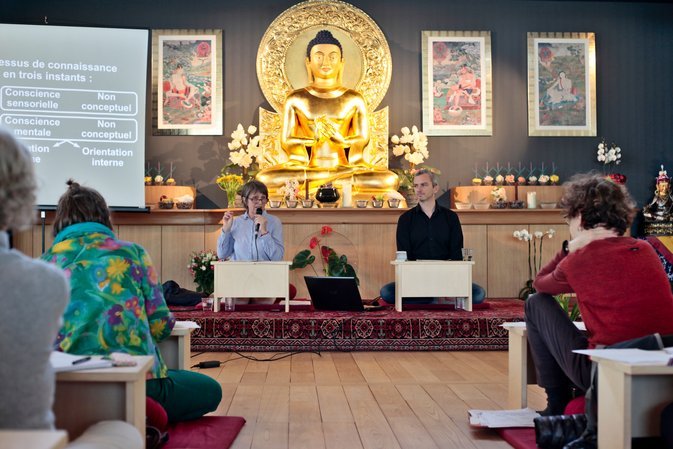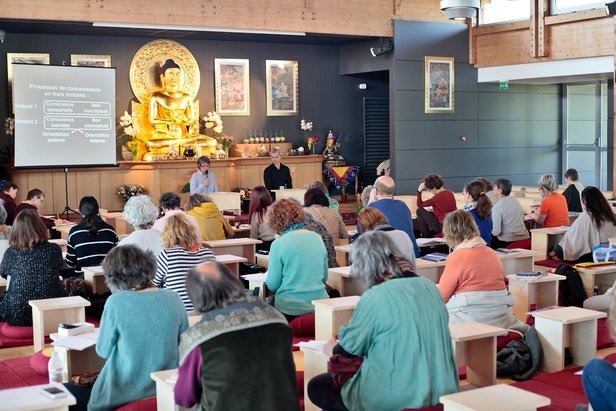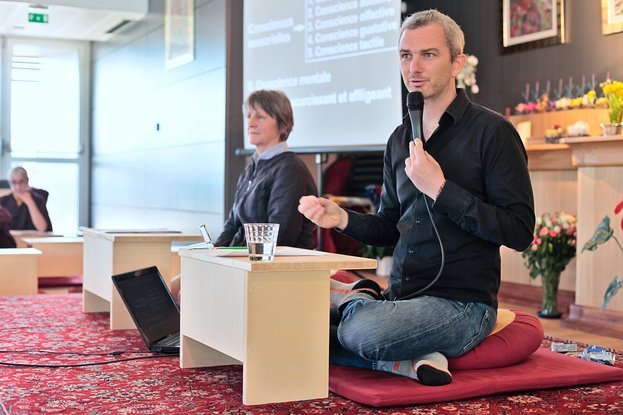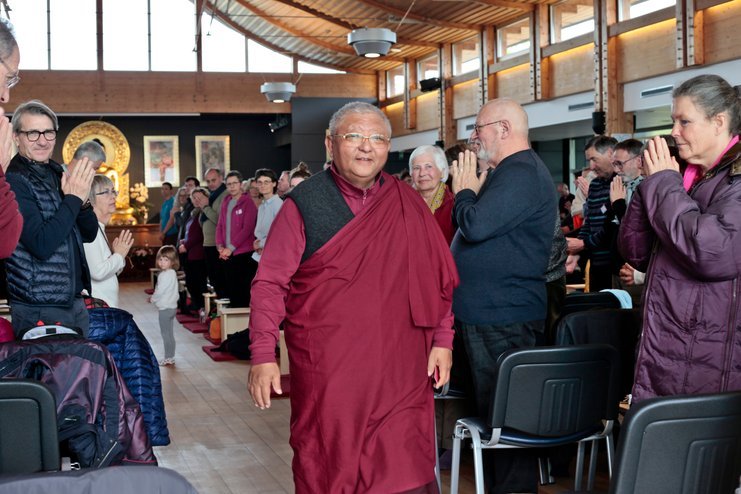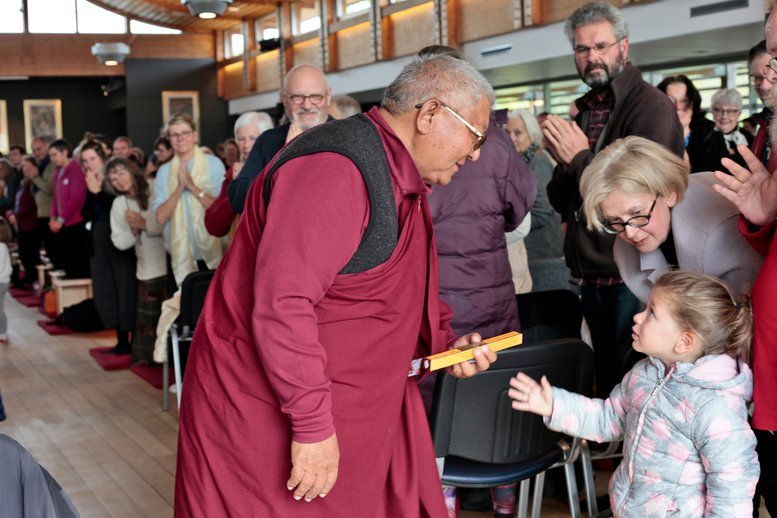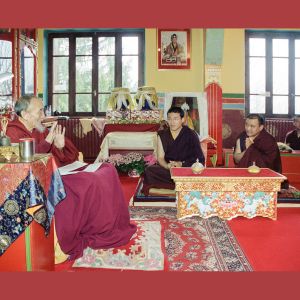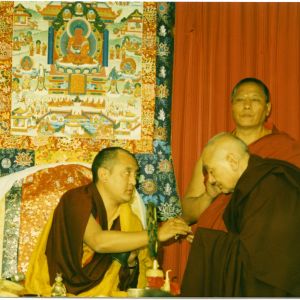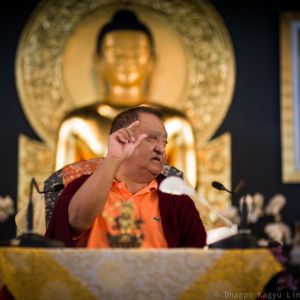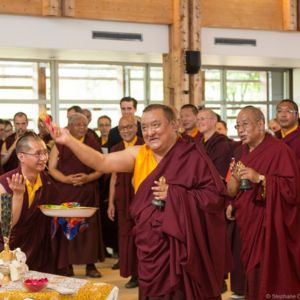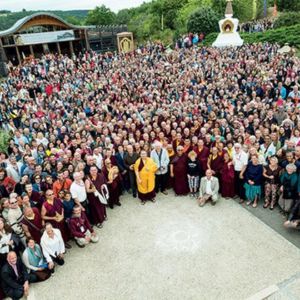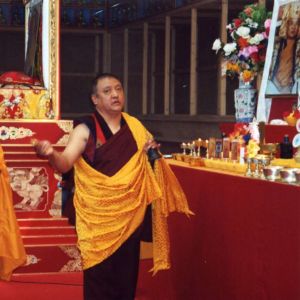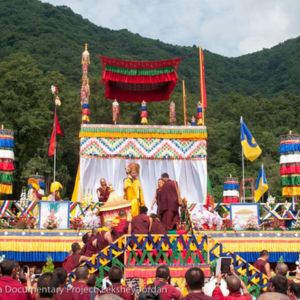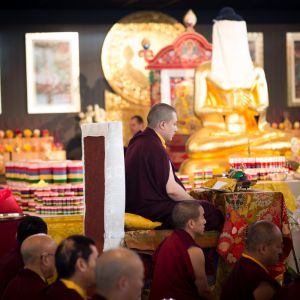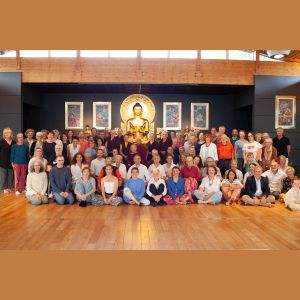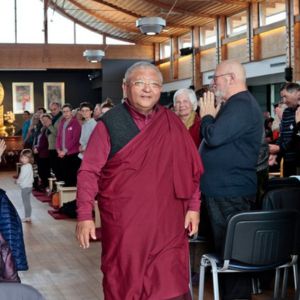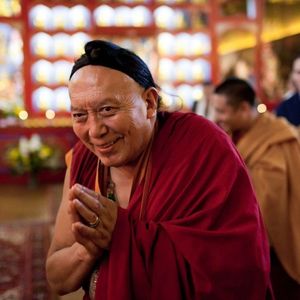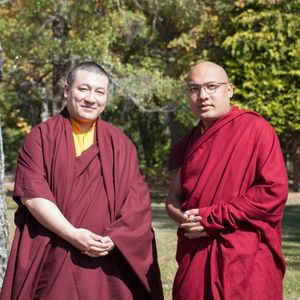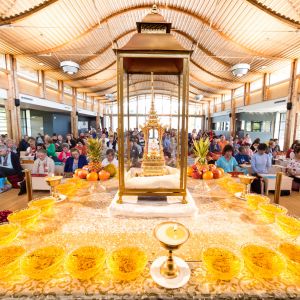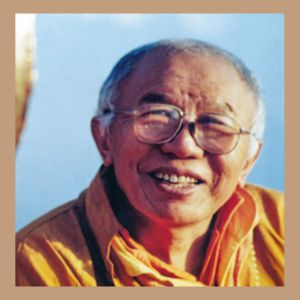
 Three times a year, for the past eight years, Lama Jigme Rinpoche has been guiding some 250 practitioners enrolled in the Chenrezig cycle, a progressive curriculum of study and meditation developed by the 14th Künzig Shamarpa, Mipham Chökyi Lodrö.
On October 4, 2018, at the opening of the very first course in this cycle, Jigme Rinpoche explained that the idea for these retreats was born several years ago, when many people consulted him about attaining accomplishment in their practice:
I asked what people wanted, what their goal was, what they needed. Two main trends emerged: those who wanted to be reborn in Dewachen, which reflects a certain degree of understanding samsara since one does not wish to be reborn there. The other goal was to know how to pass into the next life, in other words, to know how to die. This again expresses a certain understanding of the conditions of samsara with the desire not to perpetuate them, but if one must return, then it is a matter of finding the conditions to be able to continue one’s practice. This retreat is based on these two objectives.
Those wishing to enroll in the curriculum were invited to write a letter to Jigme Rinpoche explaining their interest in the cycle, what they were looking for, their Dharma background and their practices. Far from being a selection exercise, Jigme Rinpoche’s intention was to be in tune with practitioners’ progress and thus be able to respond to their needs. The same two motivations mentioned above were found in the majority of letters received by Jigme Rinpoche.
On the first day of the cycle, he emphasized that reflecting on the purpose of practice is essential in order to embark on the path and obtain fruits.
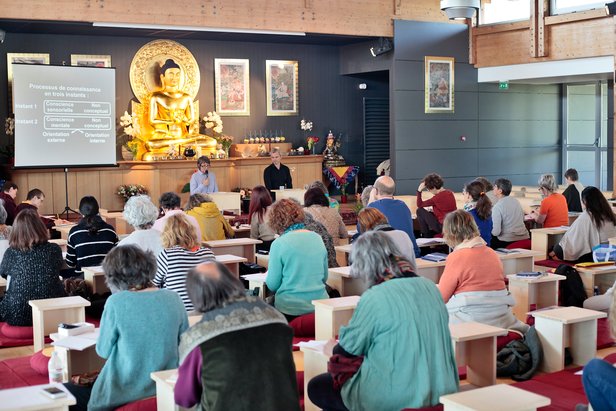 Participants are asked to commit fully to the curriculum by attending the three annual retreats and carrying out the practice of study and meditation between each session, to the best of their ability.
Each retreat includes time for meditative practice, teachings by Jigme Rinpoche, and presentations of fundamental Buddhist texts by students of the Institute trained by Khenpo Chödrak Rinpoche.
Since 2020, the curriculum has also been available online on YouTube.
At the opening of the first retreat, Jigme Rinpoche explained the thrust of the study and meditation curriculum:
It is a combination of various ingredients. On the one hand, there is the aspect of learning the teachings. They are like a map, a plan that allows us to know where to go. On the other hand, there is the practice, which is to follow the direction we have seen on the map. […] It is about remaining in our own wisdom, our own Buddha nature, in the essence of the mind that is not fabricated. Currently, our mind is a bit like a leaf blown by the wind: it follows one illusion after another, one concept that arises after another. On the contrary, the idea is to attain this dimension of Buddha nature that is free from all illusions and ignorance.
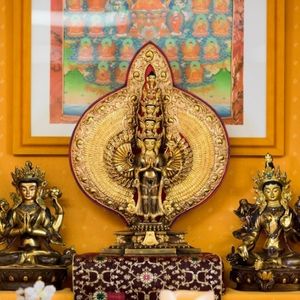
It is because we are unable to remain in our own wisdom that Shamar Rinpoche encourages us to practice Chenrezig meditation as transmitted according to the instructions of the 15th Karmapa. This practice is very effective and easy to implement. It allows us to actualize the goal of meditation through the practice of Chenrezig and by following the instructions given in the teachings on Mahamudra.
It was during this first retreat that Jigme Rinpoche gave several guidelines for practice: first, to prepare the mind for meditation by starting to relax. To do this, sitting before an open and calm landscape, we let our gaze rest in the distance at the beginning of the session. Jigme Rinpoche explains:
The more you manage to remain relaxed, the more clarity about what is happening in the mind will arise.
Second, we need to connect with Chenrezig, our own wisdom nature, throughout the day, by beginning the practice in the morning with the recitation of the mantra and formally concluding it at the end of the day. By remembering and reciting the mantra in a multitude of daily situations, we purify harmful seeds and create new tendencies in the mind that can lead us on the path to liberation. Jigme Rinpoche emphasizes:
Taking care means putting into action the causes that purify these harmful seeds or imprints.
During each session, for an hour and a half each afternoon, practitioners study Entry to the State of a Pandita by the first Mipham Rinpoche, a treatise whose “purpose is to obtain the discernment that will determine without error the mode of being of the knowable.”
Thus, for eight years, the Institute’s students have been repeating this text, which they studied with Khenpo Chödrak Rinpoche, addressing topics such as aggregates, dhatus, ayatanas, dependent arising, and the truths of the noble beings.
This text is not necessarily easy to understand at first glance, but it will be extremely useful,
said Jigme Rinpoche during the very first retreat, where he encouraged participants to form study groups in order to better understand the fundamental concepts on which meditative practice is based, to remember them, and to gradually clarify any confusion that arises in practice. In October 2023, the Institute’s students began to repeat Vasubandhu’s Abhidharmakosha.The curriculum is described as progressive because, as Jigme Rinpoche points out:
The idea is that the mind absorbs these concepts and stays as close as possible to the teaching… This takes time, a bit like a turtle slowly climbing a mountain—despite its slow pace, it progresses steadily, and therefore, at some point, it reaches the top of the mountain. You really have to take what has been said seriously, do it with sincerity and devotion, and that is what will enable your practice to evolve in the right direction.
Jigme Rinpoche accompanies practitioners in the same way that a retreat master guides meditators; he gives instructions to be put into practice. Practitioners who follow them share questions or feedback. Jigme Rinpoche can then assess meditative progress and offer guidance and corrections. Progress from one retreat to the next depends entirely on how the entire group has implemented this meditative practice.
Given by Jigme Rinpoche during several courses, the oral explanations on the practice of Chenrezig were published in English in 2023 in a booklet entitled Explanation of the Meditation-Recitation of Chenrezig according to the Commentary of the 15th Karmapa Khakhyap Dorje, Continual Rainfall of Benefit for Beings.