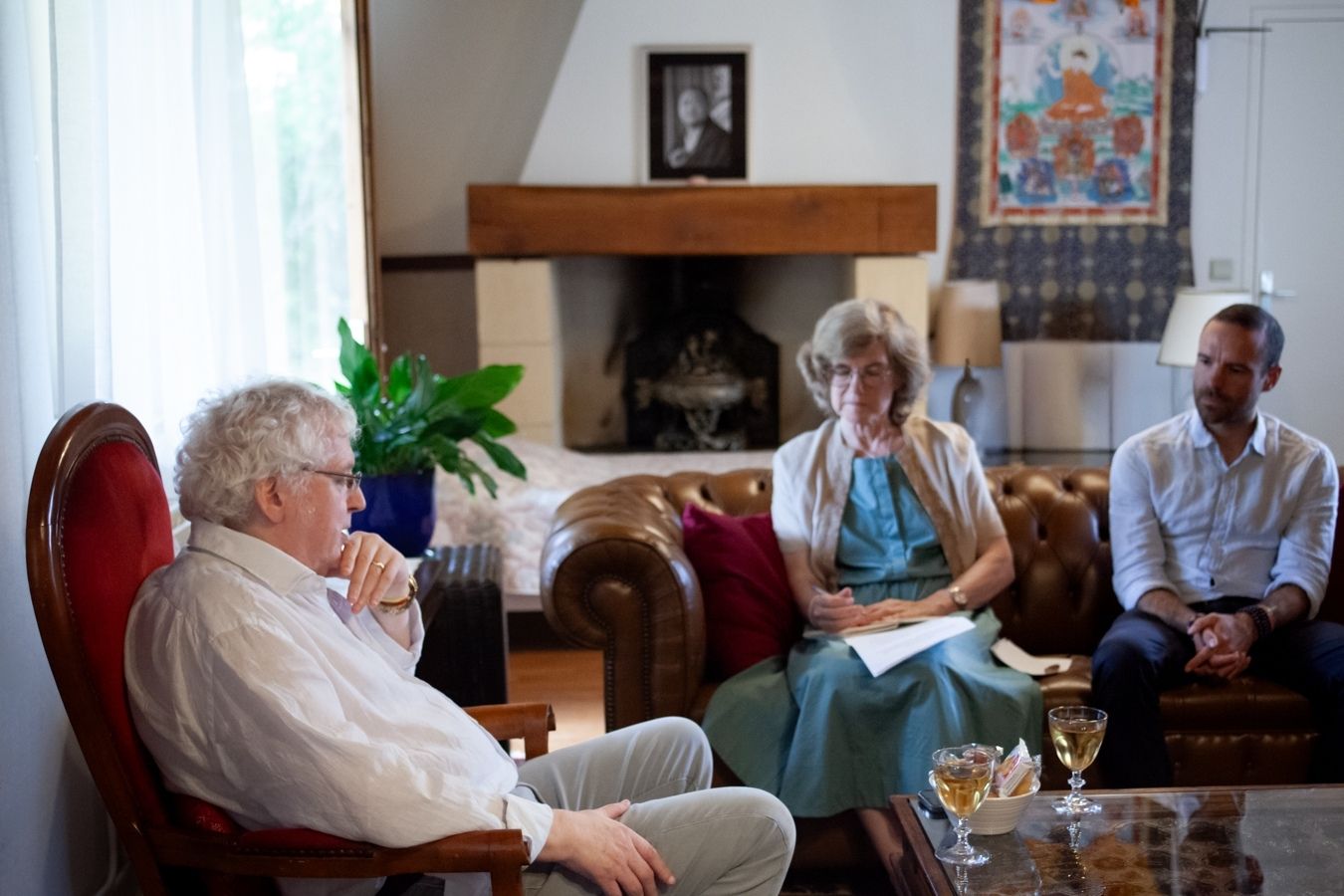
In July 2026, British-born Lama Jampa Thaye spent a week at Dhagpo Kagyu Ling to pursue his teaching on the Seven Points of Mind Training (lojong), based on his master Karma Thinley Rinpoche’s commentary[1], and on Sakya Pandita’s three disciplines (dom sum). He is among the eminent teachers who have been sharing the Dharma at Dhagpo for many years. In continuity of our fiftieth anniversary, we spent some time with him during his stay to find out more about his unique spiritual journey and his views on anchoring an authentic Dharma in the West.
Shamar Rinpoche had an unerring vision
that goes with his radical honesty in every matter.
You encountered Buddhism at age 20 in Manchester in 1973 and followed the 16th Gyalwa Karmapa on his first visit to the United Kingdom the year after. Could you share with us your recollections of this time?
Everything was happening in a rush in those days, with the coming of the Dharma to Europe. It felt that no sooner had I taken refuge in 1973, with Karma Thinley Rinpoche that I met H.H Sakya Trizin the following year, and Kalu Rinpoche the same summer in Manchester. A couple of months after, H.H. Karmapa came to Europe.
Looking back, it is astonishing that so much happened so quickly. But then, of course, because you’re young, and you don’t know anything to compare it with, it’s like, “Oh, maybe this is normal for a Tibetan Buddhist”. It was a very happy, joyous, rolling time. When H.H. Karmapa came, everybody knew each other – there were at most one hundred of us.
I went to Scotland when H.H. Karmapa gave the Black Crown Ceremony in Samye Ling. Then I met him in Chime Rinpoche’s place in Essex. Of course Jigme Rinpoche was there too.
The principal thing Karmapa gave there was Dorje Pamo. Some of us had been doing ngöndro for a year by the time Karmapa came. He only wanted to give it to those who finished ngöndro. But literally, there wasn’t anybody! So the rule was re-extended to having finished Dorje Sempa. There were probably just around twenty of us there when Dorje Pamo was given. Karmapa gave a couple of other initiations and ordained about twelve people. Karma Thinley Rinpoche had told me the previous summer not to get ordained as it wasn’t the way for me. There were also trips to London and Cambridge with Karmapa for him to do the Black Crown ceremony.
It’s such an enormous power in his presence that you were swept off your feet you could say. Karmapa was also like this extraordinary loving father. He was 53, I was around 21. And it was the same with the young lamas around him like Jigme Rinpoche. It just further amplified that feeling, because it was like he was travelling with his sons.
Shamar Rinpoche wasn’t with the Karmapa on his two first visits to England. I first met him in 1981 at a centre in Germany (Kamalashila), where a conference was being held. I saw him manage difficult situations with such dignity and clarity.
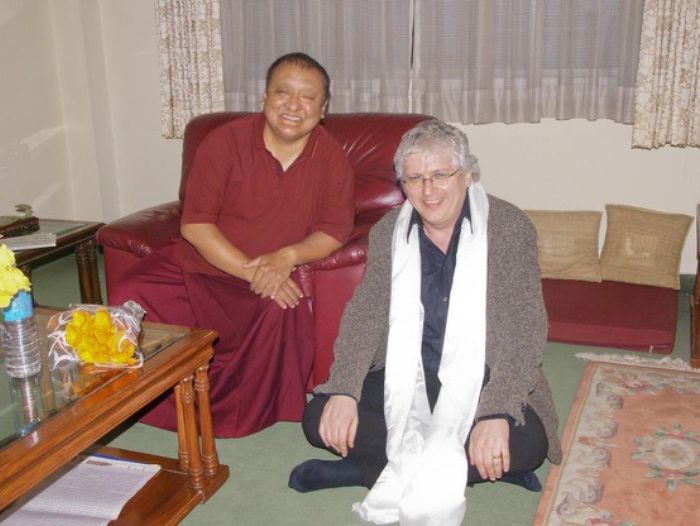
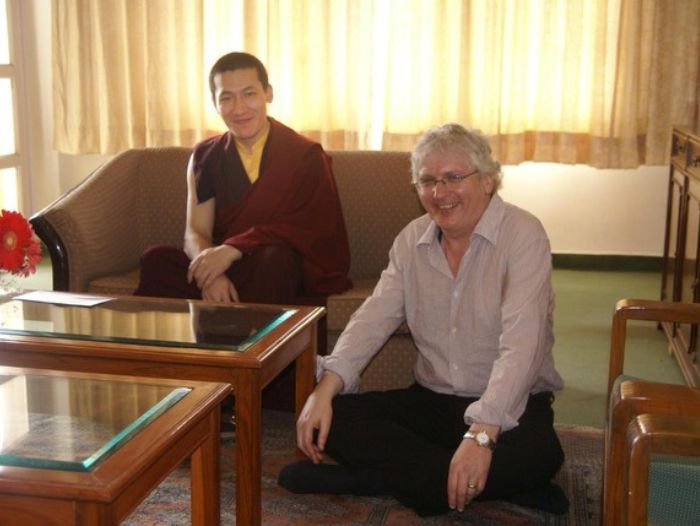
With Künzik Shamarpa, KIBI, New Delhi, 2009
I was able to spend a little time with him and that was really impressive to me. We met again after many years, in 2007, at the Karmapa International Buddhist Institute.
It wasn’t until 2013, when Shamar Rinpoche came to England, that he asked me to go to America to teach Zhentong Madhyamaka. He passed away two weeks after he’d been with us in Manchester and I thought that would fall into abeyance.
But he’d actually rung them in American Bodhipath, immediately that day. So that’s how I ended up going to Bodhipath in America, and then through that, in Europe.
Only the external appearances, to a certain extent, may vary. But the inner Dharma, the Dharma taught in the Sutras and Tantras that our great masters of Kagyu, Sakya and Nyingma have preserved, cannot change, because it’s like a medicine. The packaging of the medicine may be different, but for the medicine to work, it must remain powerful, as prescribed by the Buddha and preserved by the great masters. So in some ways, there’s very little adaptation. But on the other hand, we have to be able to speak intelligently about this, to people who know nothing.
So there’s a great deal of work in terms of establishing the rationality and the practicality of Dharma. It’s going to take some time. There can’t be shortcuts. But in terms of compromising to win audiences, it’s a dead loss. Because if we compromise the essential Dharma teachings, its radical demands on us, whether it’s in ethics or whatever it is, in philosophy, what are we selling? We’re selling bogus.
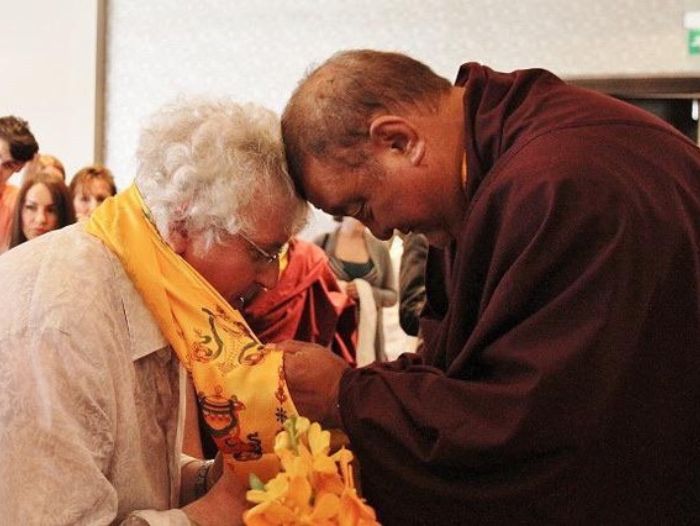
With Künzik Shamarpa, Manchester, 2014
Exactly. I even sometimes see lojong being appropriated by non-Buddhists, when, of course, the whole context of lojong is its Bodhisattva training. There are many such instances. And, of course, when you get to the selling of Vajrayana initiations on the Internet and so on, then that’s really quite disastrous.
Going back to Shamar Rinpoche, he was extraordinarily orthodox, but as I once said, he’s radically orthodox. He could see through what were merely cultural accretions – some which are not not bad – but which could obscure the real Dharma. There’s so much of the real Dharma to teach that we can’t waste time on cultural accretions.
So I think Shamar Rinpoche had an unerring vision that goes with his radical honesty in every matter. Shamar Rinpoche forces us to examine the way of understanding the teaching. If we have to then present it to others, we’ll do so with a great kind of fidelity to the tradition, but an intelligent fidelity. If we had to give it a brand, it would be “intelligent tradition”.
On the coming and going, serious people sometimes have different orbits around the Dharma, like an orbit of a planet around the sun. Some people are very close to the lama and the teachings, others, maybe for family and work reasons, only see the lama occasionally and come to teachings from time to time. You may think they’ve stopped practising, but actually no, they’re just practising in their own home and their own space, in their own way. I think all healthy Dharma communities – meaning a cluster of people around a lama – are like that.
The great thing in Kagyu, Sakya and Nyingma is that we’re clusters around a particular lama, but we’re in other clusters too. So in the Karma Kagyu over the years, you develop a relationship, a samaya in fact, with quite a number of teachers.
I think that makes it rich.
The monastic Sangha is crucial for the Dharma, because according to tradition, it is one of the three supports. You can’t have a temple without the Buddha statues, the Dharma texts, and the monastic Sangha.
For lay followers, only then are the three bases on which merit can be accumulated in place. A Dharma country is not a Dharma country without monastics. It’s non-negotiable that there must be a Sangha. For us lay people, no matter how engaged we are in practice, and some having responsibilities as lamas and so on, we cannot think there can be a non-monastic Dharma. The Vinaya rules for novices and fully ordained monks and nuns, they’re what make the monastic life work.
With H.H. the 17th Gyalwa Karmapa, KIBI, New Delhi, 2008.
We can’t just duplicate the Tibetan way, which is itself proving difficult. H.H. Karmapa is thinking about this very much, with the Karmapa Education Centre, as is the 43rd Sakya Trizin who has also established an academy for young children, some of whom will become monks.
What should we do as Westerners? I don’t know the answers, but I just know that monasticism is crucial. In our lay role, we support Karma Thinley Rinpoche’s nuns in Nepal and of course I see the same with the monks in KIBI and H.H. Sakya Trizin’s monks.
The best minds need to be bearing on this, because turning monks and nuns into guarding a theme park for money, I don’t think that will work. It will corrupt them, because a certain space needs to be kept between lay people and monastics. Quite often in the West, where there’s been a couple of monks in a center surrounded by lay people, it’s deteriorated, because there’s not enough respect and distance for the monks.
So we need big institutions with a good economic basis to create monasticism. I think monasticism is going to come more slowly in terms of development in the West, but we lay people, involved in Kagyu and Sakya and so on, must never forget that we’re working towards that. It’s a very complicated issue.
And while there are still some of our real lamas who are monks, like Karma Thinlay Rinpoche who is close to 95 and Lama Jigme Rinpoche, this is another way to remind ourselves of the centrality of the monastic career. A lay Buddhism won’t work.
I’m not so engaged myself in it at the moment, but we have people who are. I think the first thing is to translate the texts on the syllabus, both Mahayana and Vajrayana, and the leading works of the great masters of these traditions. Quite a lot has been done.
Translations, like the very original Tibetan or Sanskrit texts themselves, are just supports for teaching. They’re what you work with after the teaching. So just publishing for the sake of publishing, getting ever more exciting tantric books onto the publishing market, I don’t see that as good. In fact, I see it as quite negative for Dharma.
I think the job of translators is rather a modest one, which is as a teaching support. Of course, we have to have nice-looking, durable books, and therefore I’m very delighted with the existence of publishers like Rabsel Publications who support the Dharma in a pure way without any compromise.
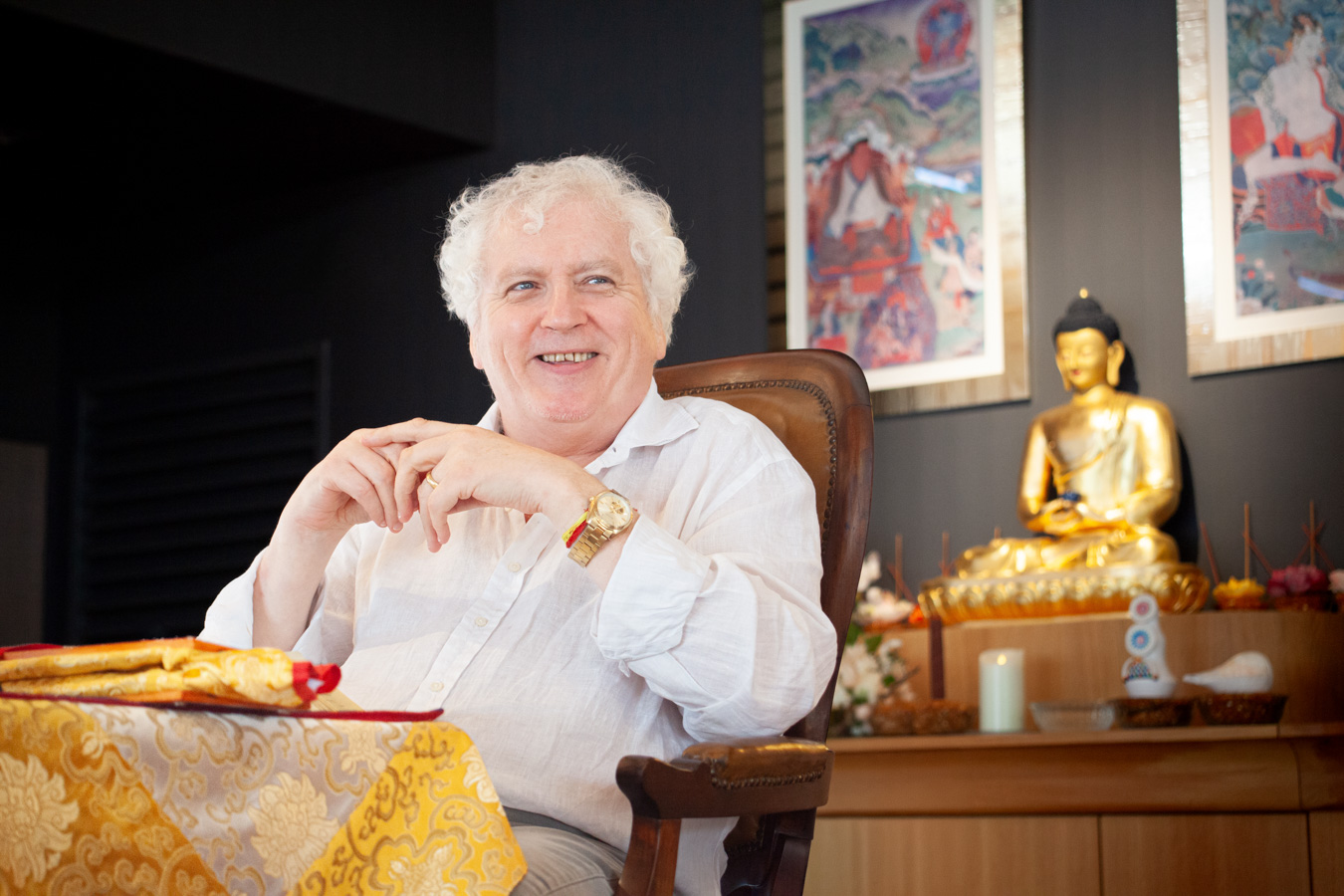 The enriching of the curriculum to support people’s practice has been given careful thought by H.H. Karmapa, Shamar Rinpoche and Jigme Rinpoche. Khenpo Chödrak Rinpoche plays a very important role, and Trinlay Rinpoche and myself also have a role.
I ‘m really happy about this because Dhagpo is the mothership of Karma Kagyu in the West. It is the seat of His Holiness the Karmapa. So it’s so important that the Dharma flourishes here. It will radiate out from here.
Jigme Rinpoche is General Secretary to H.H. Karmapa so it gives him a kind of guardian role of the Karma Kagyu. I always insist when I go to other centres in Europe, and even in America, that everybody should look to Dhagpo because it is Karmapa’s center.
For authenticity, for training, this is the main source to draw upon. I see participating in that as a very great service to the tradition and to His Holiness and I’m very happy about it.
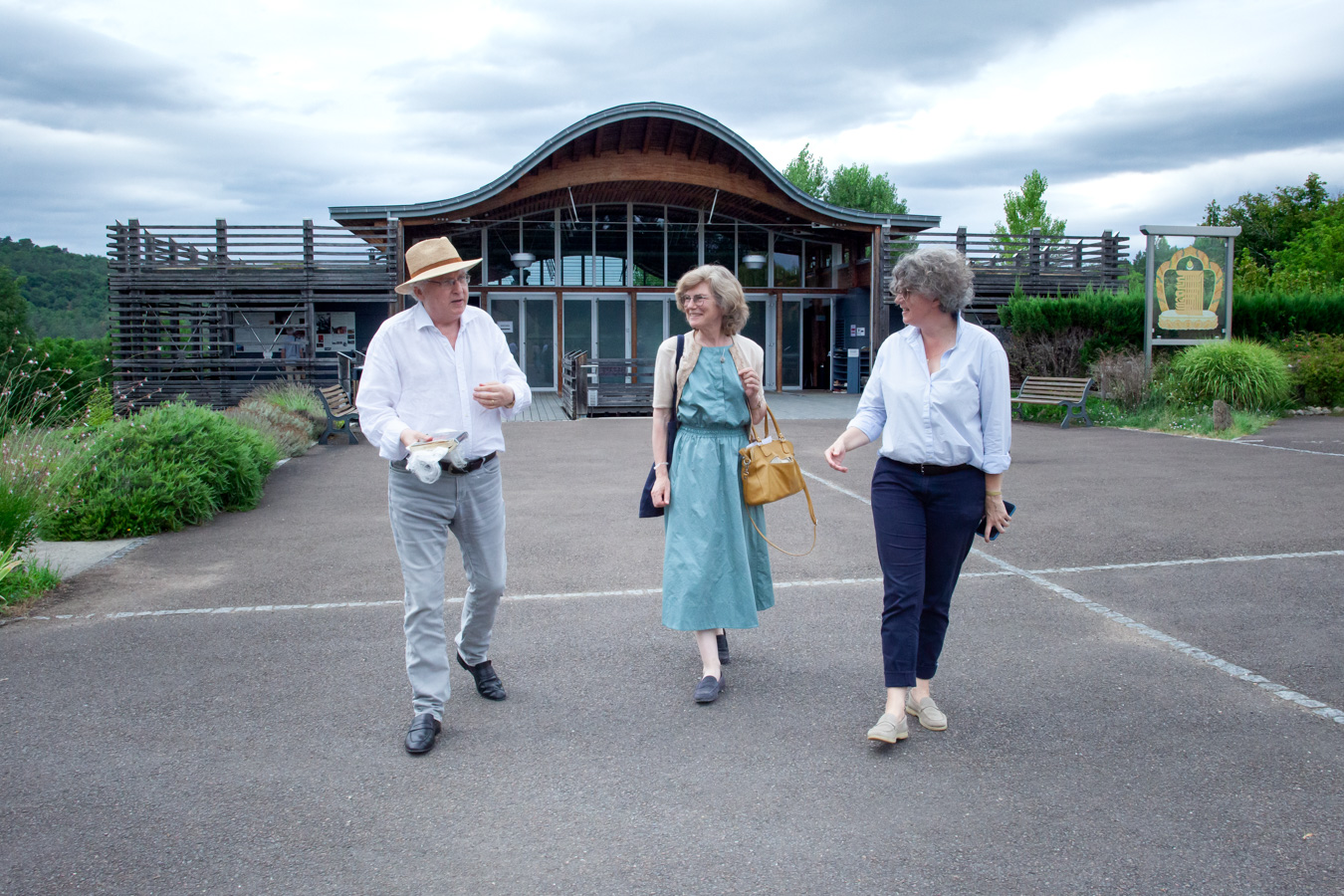 That Jigme Rinpoche remains for a long, long time is very important for Dhagpo and for Kagyu. It’s also for His Holiness of course, but he’s very, very important. Nobody should lose sight of that. And nobody should lose sight of the fact that he’s the authority. Everything should be referred to Rinpoche. We mustn’t let Rinpoche neglect his health. That’s very, very important.
[1] Karma Thinley Rinpoche. Dispelling the Darkness of Suffering. Rabsel Publications, La Remuée, France, 2023.
Books by Lama Jampa Thaye published by Rabsel Publications.
- Diamond Sky. Preparing for Vajrayana. 2023.
- A Garland of Gold. The Early Kagyu Masters in India and Tibet. 2022.
- River of Memory. Dharma Chronicles. 2021.
- Patterns in Emptiness. Understanding Dependent Origination in Buddhism. 2019.
- Wisdom in Exile. Buddhism and Modern Times. 2017.