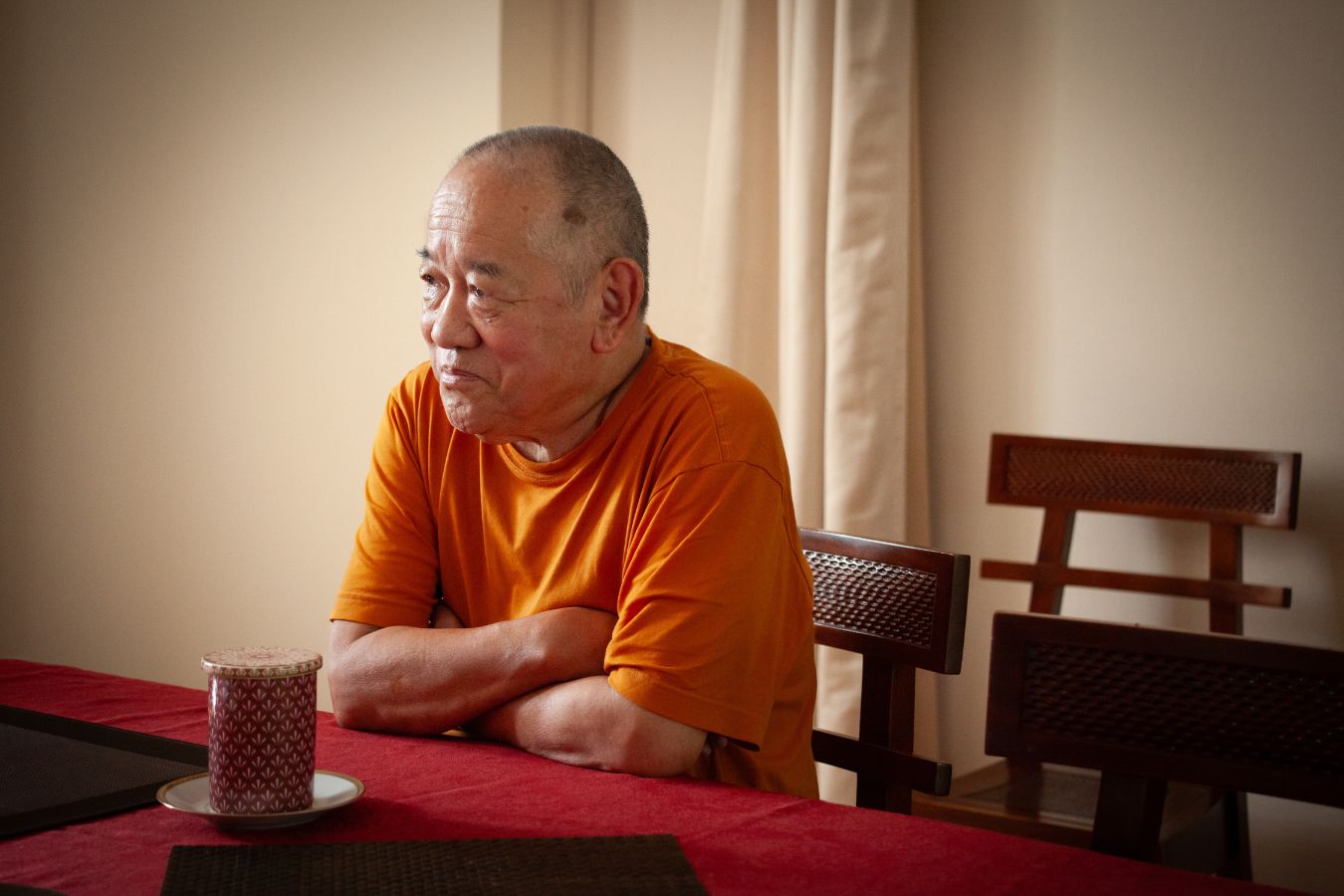
Since the launch of the summer university in 1994, Khenpo Chödrak Tenphel Rinpoche has traveled to Dhagpo Kagyu Ling every year to teach Buddhist treasures of knowledge. This year, he continued his explanation of The Stages of Meditation, a treatise by the 8th-century Indian pandit Kamalashila. On this occasion, as part of the celebrations marking Dhagpo Kagyu Ling’s fiftieth anniversary, Khenpo Rinpoche shared his life story—from his childhood and journey into exile to his spiritual education and experience as a teacher—a life dedicated to serving others and guided by an unwavering devotion to the 16th Karmapa.
The Dharma Is Universal
Let’s start at the beginning: can you tell us about your first steps in the study of Buddhism?
My first teachers were my parents; they were the ones who taught me everything about life. When I lived in my home village in Kham, my reading and writing teacher was Dawa Zangpo. He was a great lama, an accomplished practitioner of Tara, and would come to our home.
I came from an important family. In our home, there was a Tara shrine and a shrine to the protectors, so we could easily accommodate a teacher. He also taught my sister. I must have been four years old at the time. Then, when I was about five or six, I had another teacher named Tsering Lama, a scholar of the sciences, who came from Musang (Palyul, Derge County, Tibet), an important place associated with Penor Rinpoche. It is one of the six great Nyingma monasteries[1]. He taught me certain rituals and recitations.
 When I turned seven, the conflicts with China broke out. We spent three years on the road to exile. We went from monastery to monastery. It was very difficult. When we arrived in Nepal, I was ten years old. It was very hard to find food and water. We didn’t know if we were going to die. Normally, civilians weren’t attacked, but that rule wasn’t followed. I was with my family. My father came from a noble family; he was an important figure in his home country. Since he was in charge of an entire region, many people followed my family when they left. There were 20,000 or 30,000 of us at the start, and by the end of the journey, there were only about a hundred of us left. There was a whole resistance movement, but it took time to get organized, simply because it had no weapons.
That’s what I can say to sum it up. There were many children. We would hide whenever there were clashes, but during moments of calm, we would all play together and have a good time.
Then, once we arrived in Nepal, we walked all the way to India, to Uttar Pradesh, where we stayed for four months. For parts of the journey, we were on horseback but we walked a great deal. To feed ourselves, we had to kill animals and drink whatever water we could find. Along the way, we helped people in need or who were injured.
How did you end up in Rumtek, Sikkim, where the 16th Karmapa was?
What were the conditions like? Were you able to continue your studies?
At first, the conditions were extremely spartan. There was the old Rumtek Monastery, which was very dilapidated. Water was leaking everywhere; it was dangerous during heavy rains, but that’s where the 16th Karmapa was. The monastery was built by Yeshe Dorje or Jangchup Dorje[2].
We continued our studies, as is the tradition. At Rumtek, there was Umze Samten Chöpel, our first teacher, who taught us the chants and recitations associated with the rituals. The students were Söpönla, Gyurme Tsülrtim, and myself.
Writing was taught by Phuntsok, the 16th Karmapa’s secretary. This took place between 1960 and 1964. By that time, I had memorized all the rituals that were performed. Then we moved to the new Rumtek Monastery and began studying traditional Buddhist texts with Topga Rinpoche.
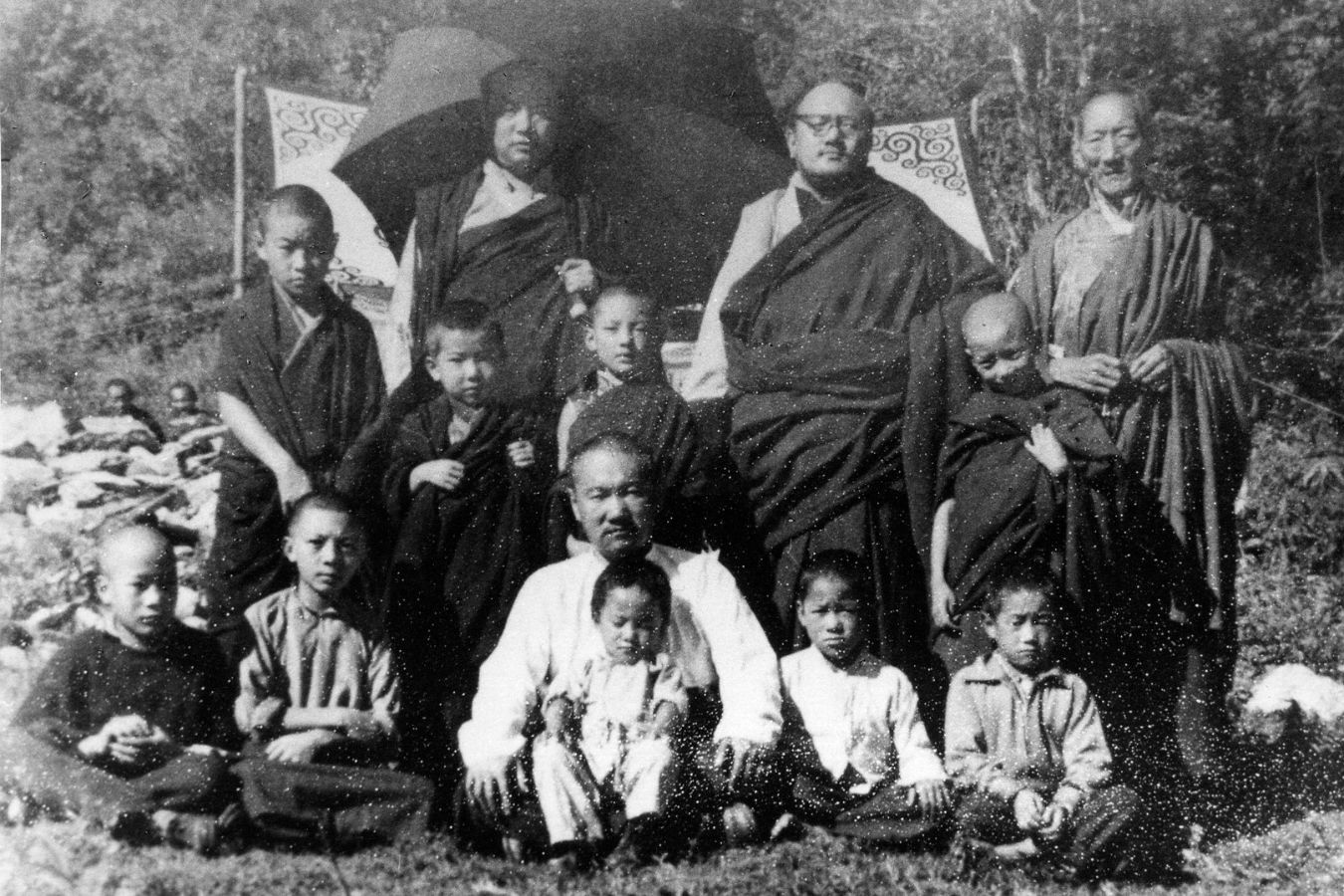
Early years with the 16th Karmapa (standing, top left) in Rumtek: Khenpo Chödrak (seated second from right), Jigme Rinpoche (fourth from right) ; Künzig Shamar Rinpoché (middle row, second from right)
My father was a minister in the administration of the kingdom of Derge; he was very knowledgeable about Tibetan history and culture. He would often tell stories over tea, so I very quickly felt that I needed to study and understand all of this. The first text I studied with Trangu Rinpoche was Shantideva’s Bodhicaryavatara (The Way of the Bodhisattva), and later, Topga Rinpoche taught us all of Thonmi Sambhota’s grammar texts; Gampopa’s The Precious Garland of the Sublime Path; and Nagarjuna’s Letter to a Friend.
There were eight or nine of us. Among us were Jigme Rinpoche, Shamar Rinpoche, Chökyi Nyima Rinpoche, Tenzin-la, and others. Afterward, we studied logic and Buddhist epistemology (tsema) with Khenpo Khedrup Phuntsok. This same Khenpo also taught the text on the three disciplines (dom sum).
It was very difficult to obtain copies of Buddhist texts. When we studied the Khejuk (The Entry into the State of a Pandita), there was only one copy that we had to share and copy out as we went along. The traditional way of studying was to summarize and memorize the text. Today, it’s different—the methods have changed. Then, for eight years, we studied the sixteen great treatises under Trangu Rinpoche.
How was the Rumtek shedra established under these difficult conditions?
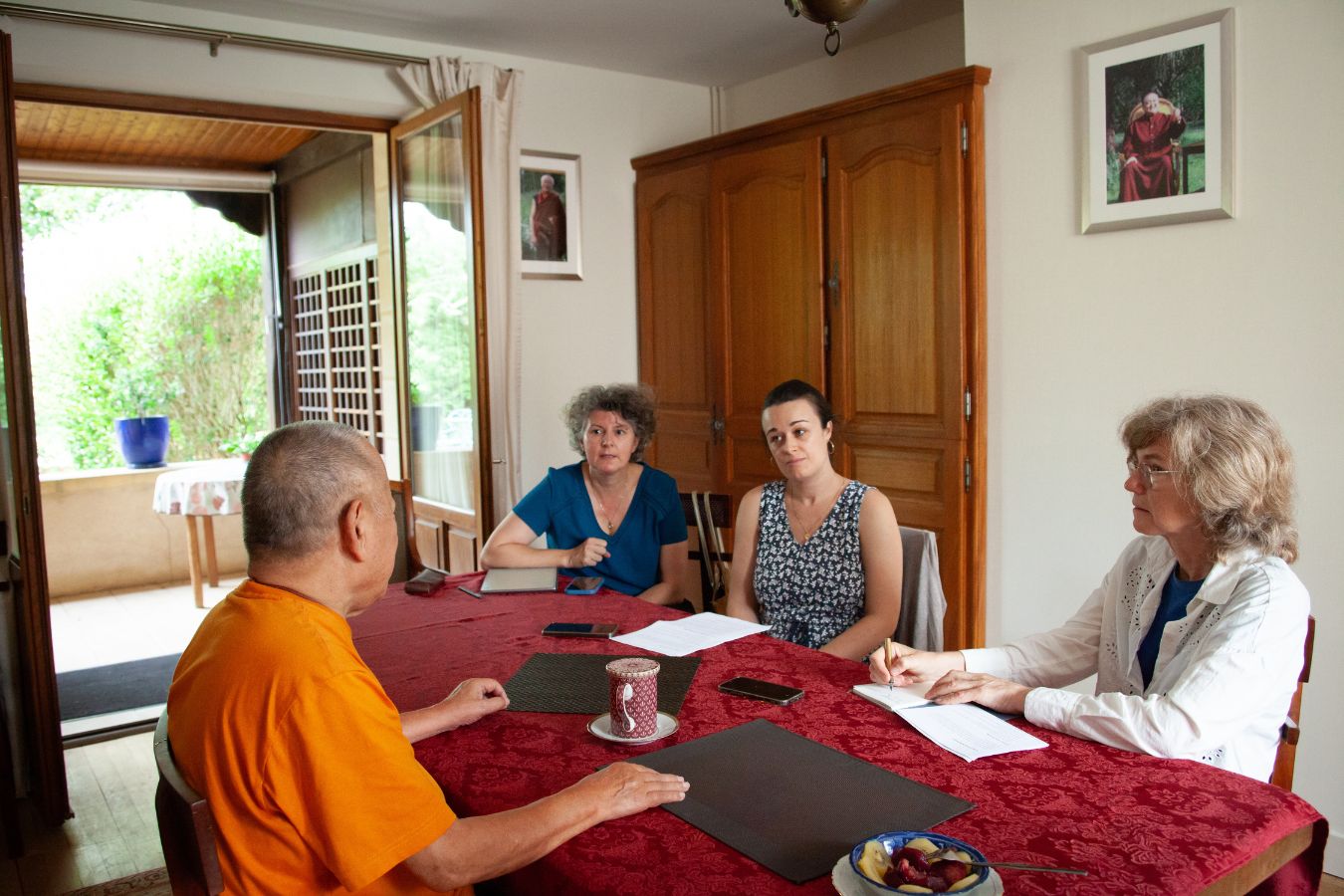
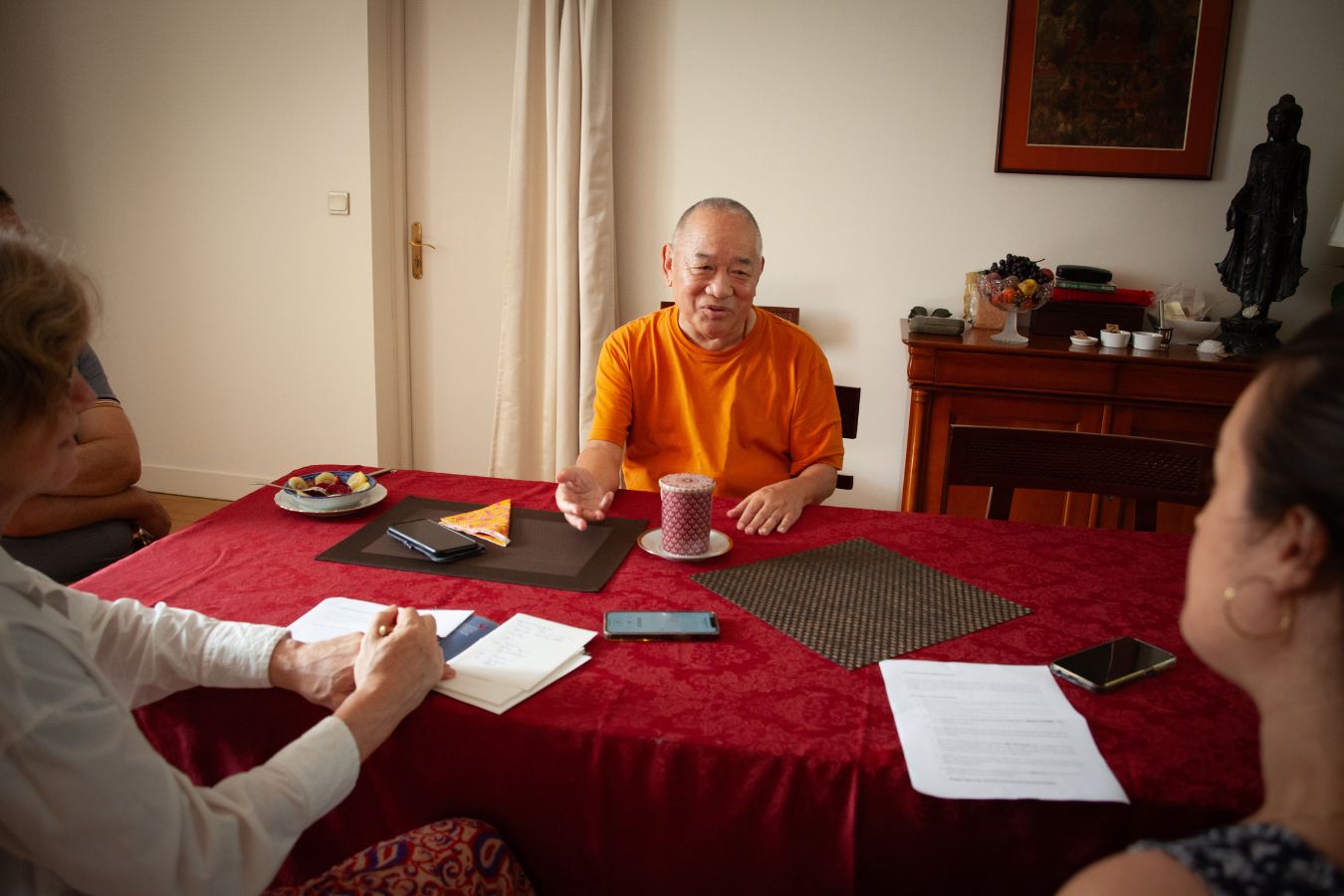
Interview with Khenpo Chödrak Rinpoche at Dhagpo Kagyu Ling
At can be said that within the Karmapa lineage, the presence of Buddhist study institutes (shedras) is very important. If one truly wishes to understand the history of the Kagyu lineage in Tibet, one must approach it as a whole. For example, during the time of the 8th Karmapa, Mikyö Dorje (1507–1554), as well as the 10th Karmapa (1604–1674), numerous shedras (Buddhist study institutes) were built. However, many of them were converted to the Gelug tradition over the course of five Karmapa incarnations, up to the 15th Karmapa, causing Kagyu education to gradually disappear.
From his earliest childhood, the 16th Karmapa was committed to building shedras. He spoke of this when he was only six years old. He devoted a great deal of energy to this endeavor: he had several shedras built in Tibet, including those at Trangu and Zurmang.
At first, in Rumtek, a number of conditions had to be met for this to be possible. It was difficult; there was no money and no connection to the West. Furthermore, even though the people on site came from very prominent families in Tibet, those ties had been severed. In addition, the state of Sikkim was under Indian protectorate, and entry was strictly controlled. In 1968–1969, one or two Westerners would occasionally visit; then, around 1972, Lama Ole Nydahl (1941–2026) and Hannah Nydahl (1946–2007) brought a few more. Around 1975, a Theravada monk from Canada, Ananda Bodhi[3], came with some Westerners, but such visits remained very rare.
Construction of the new shedra at Rumtek began in 1977. In fact, it was what was called Manjushri House. The actual shedra, in its current form, began after the passing of the 16th Karmapa in 1981. Manjushri House was an elementary school where very young monks studied. I was a teacher at that school, which had a lower and an upper grade level. I mainly looked after the lower grade, which consisted of thirteen children—very mischievous ones who were always running around and getting into trouble! Among them were Tsultim Namdak [now a qigong teacher] and Samphel Lama [Dhagpo Paris]. I was their teacher, but also their caregiver: we had to look after them, cook their meals, and wash their clothes. I gained a lot of experience; I was a bit like a mother to them. On Wednesdays, they played soccer, and during that time I carried around pots, dishes, and so on. We had to go get firewood in the forest near the cemetery. At first, I was alone; then a layperson joined us, followed by a monk. There were more teachers for the senior class, which included all the tulkus we know, among them: Sangye Nyenpa, Traleg Kyabgon, Surmang Garwang, Trungram Gyaltrul, the Nendo Rinpoche, and so on.
You mentioned during this year’s summer course that you began teaching at age 17. That’s very young!
You were the first director of the Karmapa International Buddhist Institute and then one of the first teachers at the summer university that began here at Dhagpo Kagyu Ling in 1994. What was the 16th Karmapa’s goal in establishing KIBI in New Delhi?
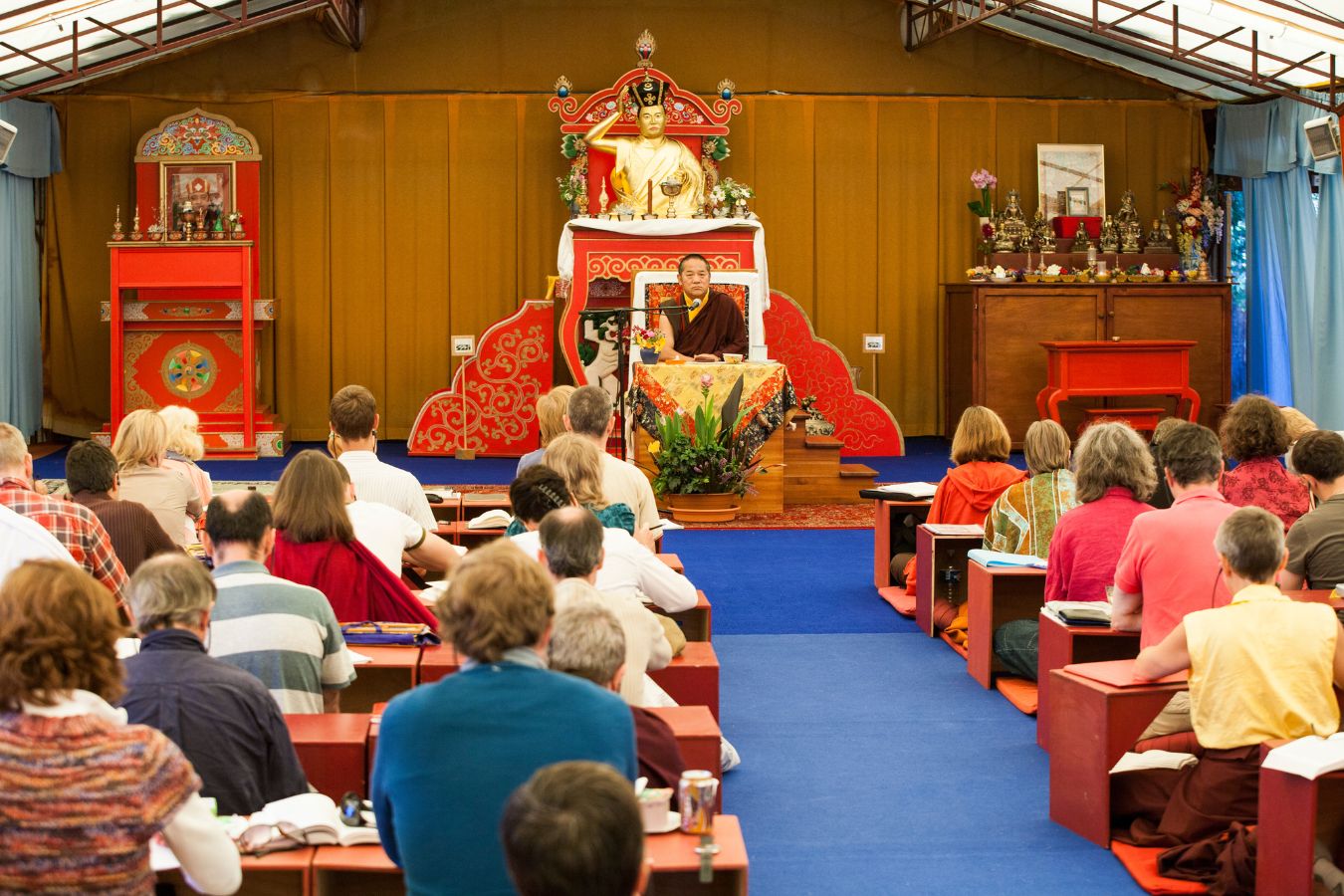
Summer university at Dhagpo Kagyu Ling, 2007
When KIBI began, the 16th Karmapa had already traveled abroad. He had realized that a place for teaching Westerners was necessary. It was with this vision that construction of KIBI began; Künzig Shamarpa brought this vision to fruition.
The goal was the same for the summer university at Dhagpo Kagyu Ling[6]: the 16th Karmapa had given instructions to Jigme Rinpoche regarding the entire curriculum to be taught there, so we began the summer course by teaching those texts.
The number of students fluctuated from year to year. Among Westerners, we can observe the importance of individual will. At Nalanda[7], students accepted what was taught to them without personal preferences, whereas in the West, students would leave if it did not align with what they wanted. If it did match, they stayed.
I received repeated requests from Lama Ole’s students to teach the Six Yogas of Naropa, and I spent a great deal of time wondering how to do so—how to handle the various aspects of this transmission. I taught it, and then came the section on powa, which has thirteen subdivisions; and as we progressed through the teaching, the students gradually dropped out: it didn’t exactly match what they wanted. There really is this distinct way of functioning marked by the importance of individual will.
This stems from a culture that has existed for centuries, whereas Dharma is very young in the West. Its establishment takes time; it is therefore normal for students to react according to their cultural habits. Learning takes place step by step, until one becomes capable of serving the Dharma. I see that now, after several years of study, Western students are capable of studying Dharma; they are no longer guided solely by their own desire or individual will.
After fifty years, the five resources recommended by the 16th Karmapa for the Buddha’s Dharma to take root in the West are now in place at Dhagpo. But the Dharma remains very young in the West. What are the basic conditions for authentic Buddhism to continue to grow and take root in our lives and in our minds?
Vasubandhu writes in the Abhidharmakośa,
“The one established in ethical conduct, endowed with listening and reflection, will fully engage in the practice of meditation.”
ཚུལ་གནས་ཐོས་དང་བསམ་ལྡན་པས། ། བསྒོམ་པ་ལ་ནི་རབ་ཏུ་སྦྱར། །
First of all, our conduct is important, so it is a matter of observing disciplines. This does not necessarily mean observing monastic discipline, but rather following the discipline of lay practitioners (such as the genyen vows) and the bodhisattva vows. Listening, reflection and meditation are important, because a process takes place through them. It is therefore a matter of listening, studying, then reflecting on what has been received and becoming familiar with it.
This is what allows us to establish a firm conviction regarding the teaching. We become increasingly familiar with the Buddha’s teachings until we realize their essence—profound emptiness. This training is not tied to our ethnicity or nationality; it is the Dharma, and it is universal. It’s not just for Tibetans!
You’re also involved with the students here in translation activities. Can you explain your approach?
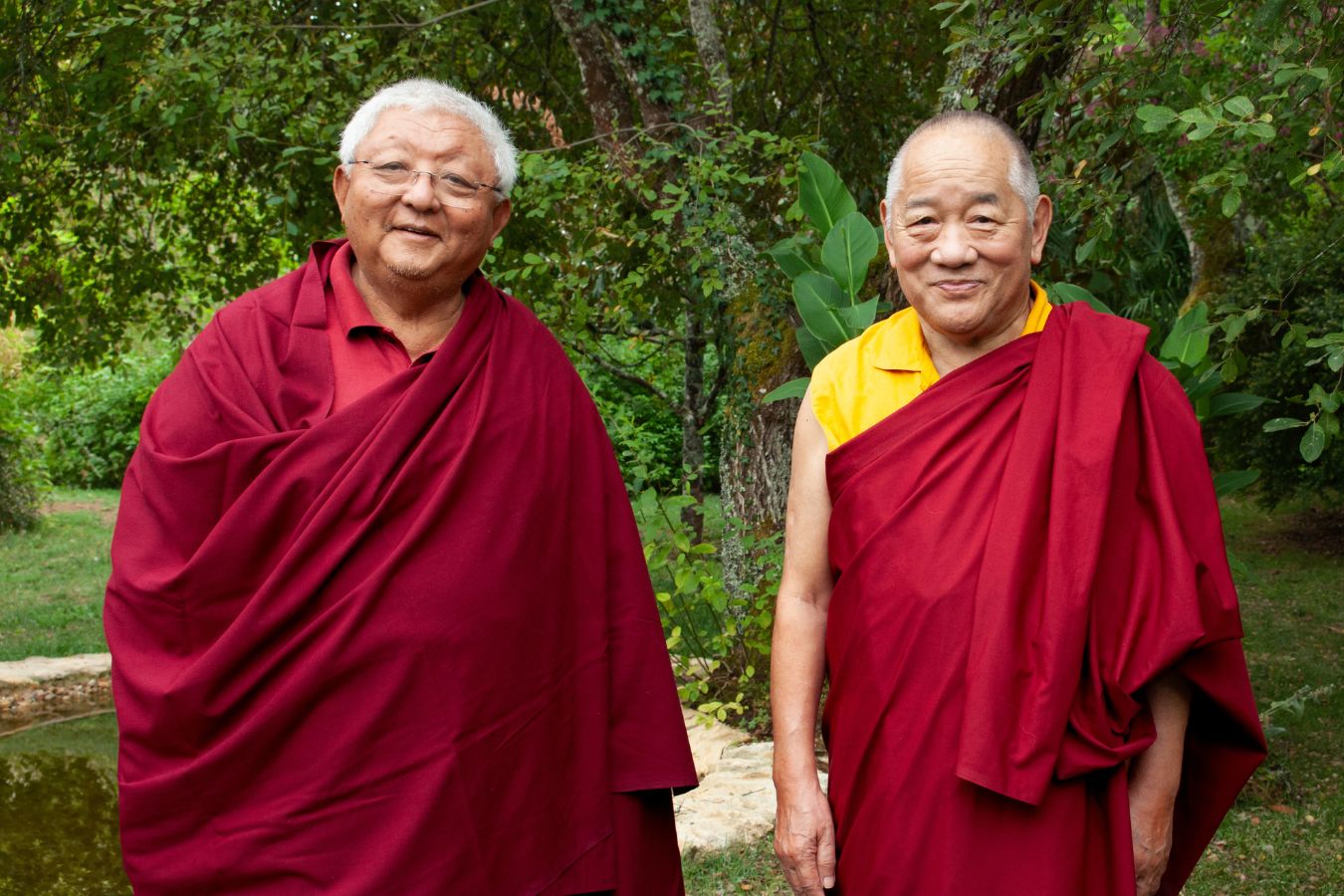
Lama Jigme Rinpoche and Khenpo Chödrak Rinpoche at Dhagpo Kagyu Ling, summer 2026
It is Jigme Rinpoche who oversees all the texts that need to be translated, for all of Europe. I pass on what I can.
If people want to learn, I give them what I can. Actually, I didn’t want to become a teacher; I was more interested in the practice itself. I wanted to go into retreat.
When I was at Rumtek, I expressed this wish. I could have found a good hermitage in Bhutan or Sikkim, where I had family.
They agreed to provide for me and take care of me if I wished to remain in retreat for the rest of my life. It was easy to arrange. I asked Trangu Rinpoche for permission, but he said he couldn’t answer and referred the matter to the 16th Karmapa.
The Karmapa gave me an instruction that made it impossible. He told me,
You must teach people; you will learn by teaching.
Honestly, I didn’t teach in the hope of receiving recognition. I did it because it was my lama’s instruction, and I cannot say no to that.
You spent a great deal of time with the 16th Gyalwa Karmapa. Is there any advice that you have always kept close to your heart?
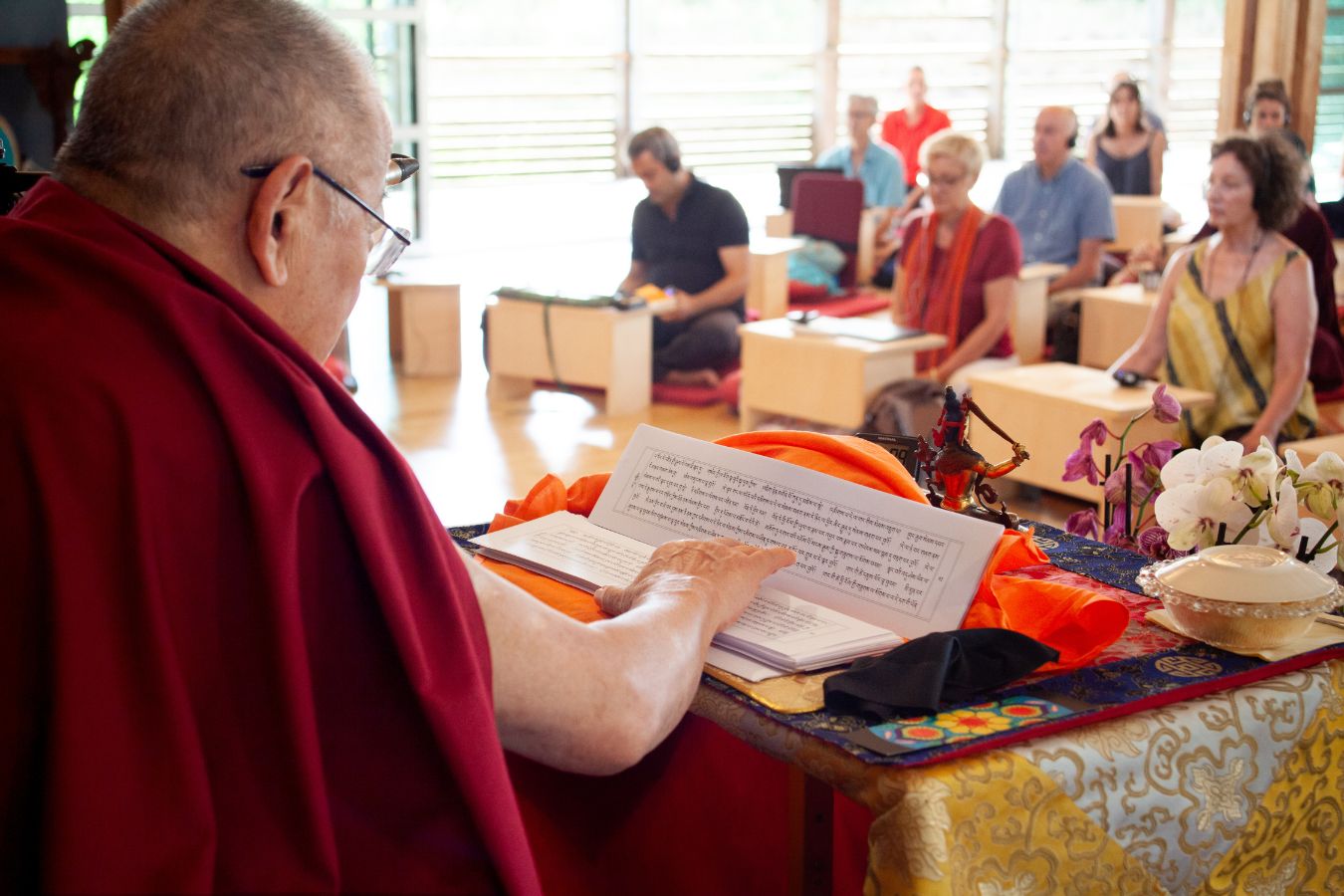
Khenpo Chödrak Rinpoche at Dhagpo Kagyu Ling
To ensure that what has been transmitted endures, pray with single-minded devotion to the Karmapa and the Shamarpa.
We may speak many words, but they are in no way comparable to those of the Karmapa and the Shamarpa, which are imbued with great blessing. We have great merit in being able to connect with them. I was able to follow and study with fifteen to twenty masters—all thanks to the 16th Karmapa and his great kindness.
Everything I observed instilled great confidence within me. This daily transmission becomes the seed of trust and devotion. Teachers influence our lives. When I was very young, I didn’t feel like learning or attending rituals, but because there was such devotion toward our teachers, whenever they urged us to do something, we did it. We had this daily source of inspiration.
[1] Khenpo Chödrak Rinpoche specifies their names: Dorje Drak, Mindroling, Sechen, Dzogchen, Khatok, and Palyul.
[2] Respectively, the 11th Karmapa (1676–1702) and the 12th Karmapa (1703–1732)
[3] Born Leslie George Dawson. He received full monastic ordination from the 16th Karmapa in 1971 under the name Karma Tenzin Dorje Namgyal, who later became known as Namgyal Rinpoche.
[4] A nun and disciple of the 16th Karmapa, who has worked to build numerous Dharma centers in Asia
[5] Fredi Bedi, a British woman, was ordained as a nun by the 16th Karmapa in 1964; she later received sramaneri ordination at Rumtek and took the name Gelongma Karma Kechog Palmo. She was one of the first Western women to receive novice nun ordination in Tibetan Buddhism.
[6] The summer university began in July 1994. See https://dhagpo.org/en/july-15-1994-launch-dhagpo-kagyu-ling-summer-university/
[7] Nalanda Institute of Higher Tibetan Studies, the shedra of Rumtek Monastery, built after the passing of the 16th Karmapa and led by Khenpo Chödrak Rinpoche.