This embodiment of awakened wisdom has recently been joined by the personification of awakened compassion in the form of a thangka of Chenrezig. Thus, the two principal aspects of enlightened qualities—wisdom and compassion—are now present together.
While this thangka serves as a beautiful support for practice and echoes the Chenrezig Curriculum established by Lama Jigme Rinpoche in 2018, it also reveals the history of the unbroken transmission of this meditation practice and invites us to reflect on what an authentic transmission of practice truly is.
The project originated from the wish of its patrons to commission a pictorial representation of the uninterrupted transmission lineages of this practice within the Karma Kagyu lineage.
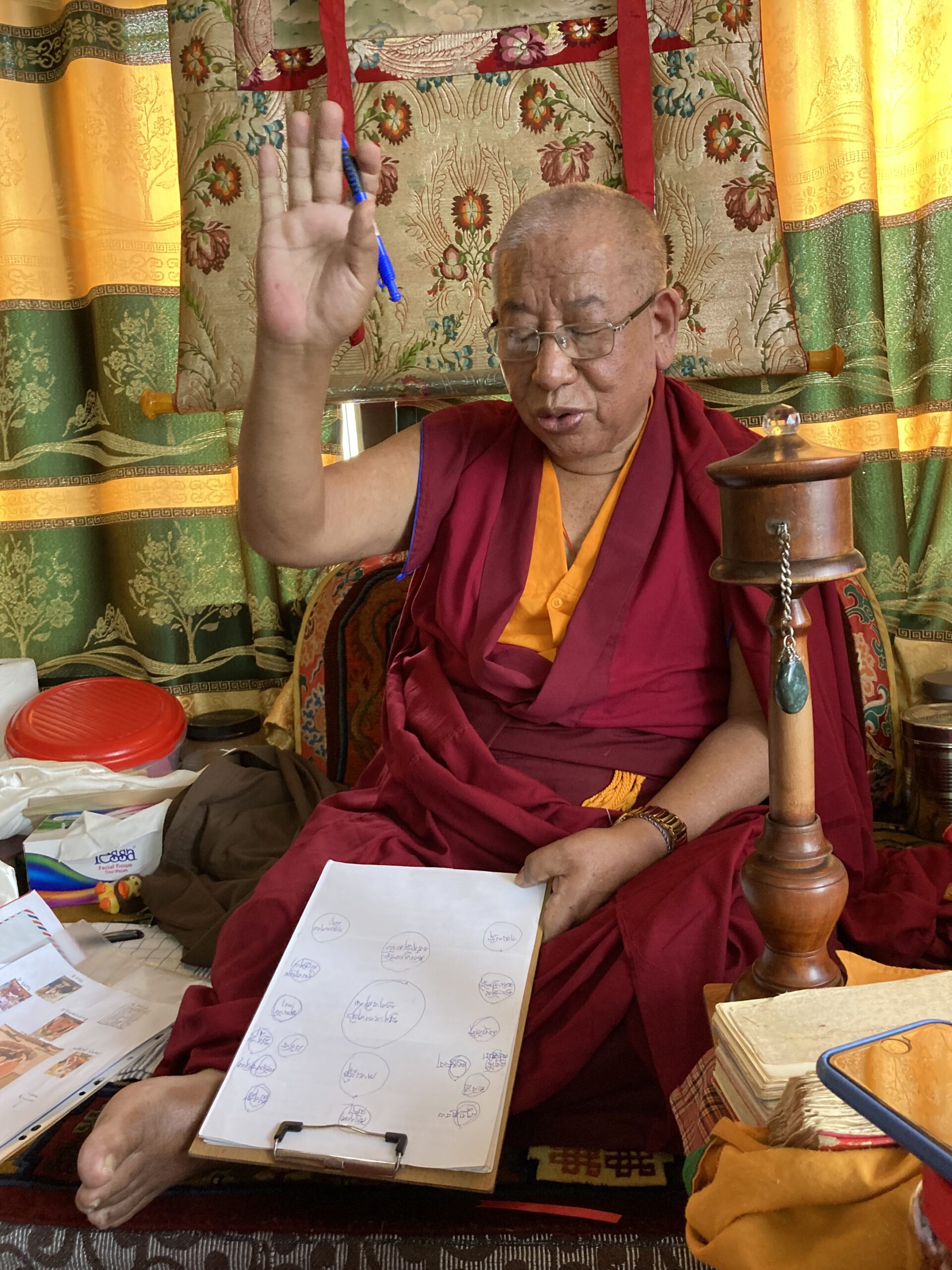
Sherab Gyaltsen Rinpoche sharing his advice
Teachings given by Thaye Dorje, His Holiness the 17th Karmapa, at Kundreul Ling in 2010 were among the inspirations for the thangka. The project was developed in close consultation with Khenpo Chödrak Rinpoche, Sherab Gyaltsen Rinpoche, and Lama Jigme Rinpoche.
The thangka was painted in Nepal by Urgen Lama, a disciple of Sherab Gyaltsen Rinpoche and heir to a family tradition of artistic transmission from father to son. Once completed, it was consecrated by Shangpa Rinpoche.
Each figure, depicted with remarkable refinement and distinctive attributes, was the subject of extensive iconographic research. This work led to the creation of a detailed design measuring approximately one meter high by seventy centimeters wide.
Then, in May 2023, from his monastery, Sherab Gyaltsen Rinpoche devoted considerable time to reviewing the thangka project, pen in hand, offering invaluable guidance on the depiction and placing of the masters. The patrons and the painter, Urgen Lama, were present, and the artist then had all the elements necessary to complete this unique work.
Reading the Thangka
Surrounding Noble Four-Armed Chenrezig are all the lineage masters who not only received these teachings but fully integrated them through practice until they encountered Chenrezig face to face. Each of these teachers attained both knowledge and realization—that is, a complete, stable, and lived assimilation of the teachings.
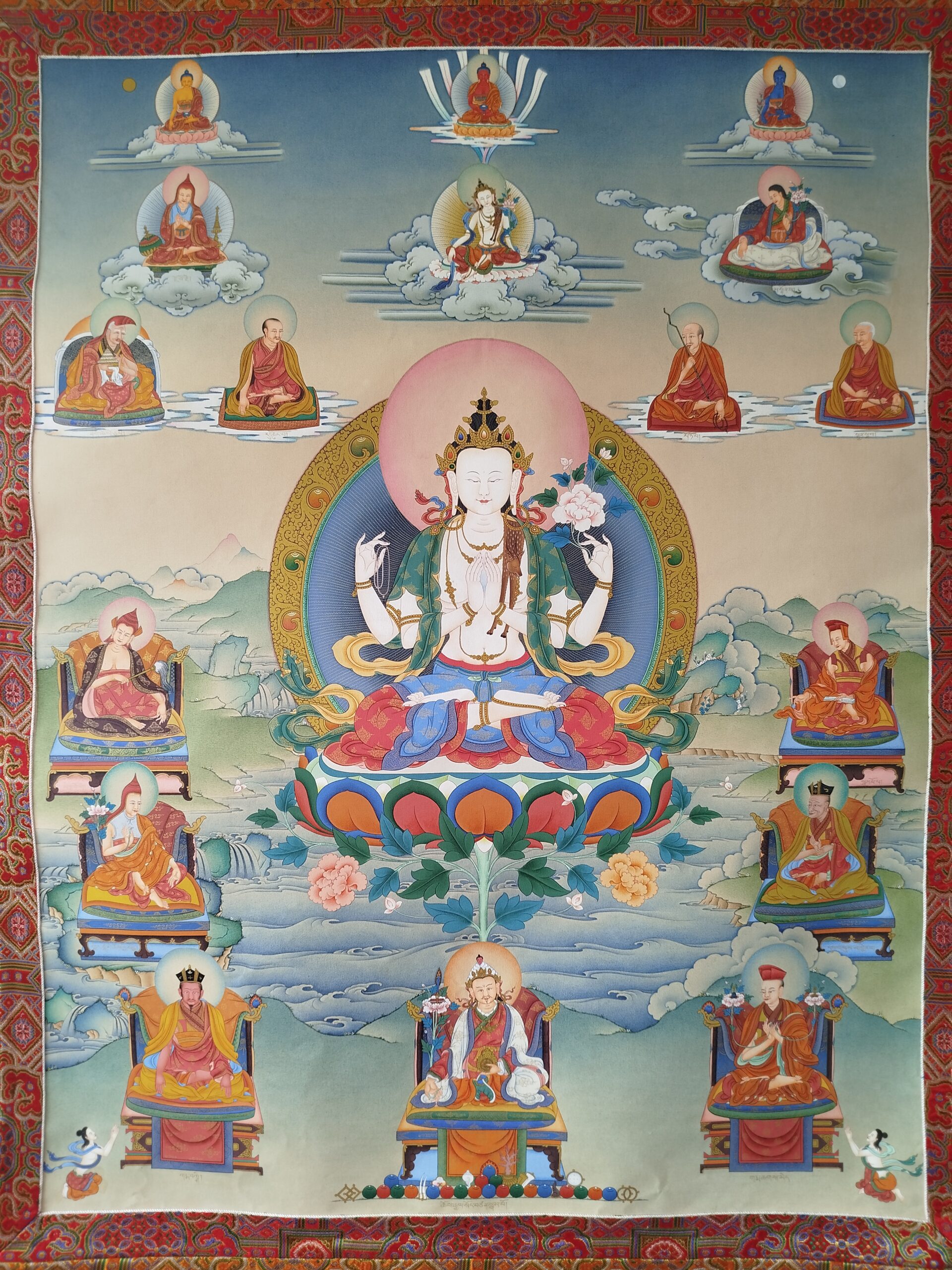
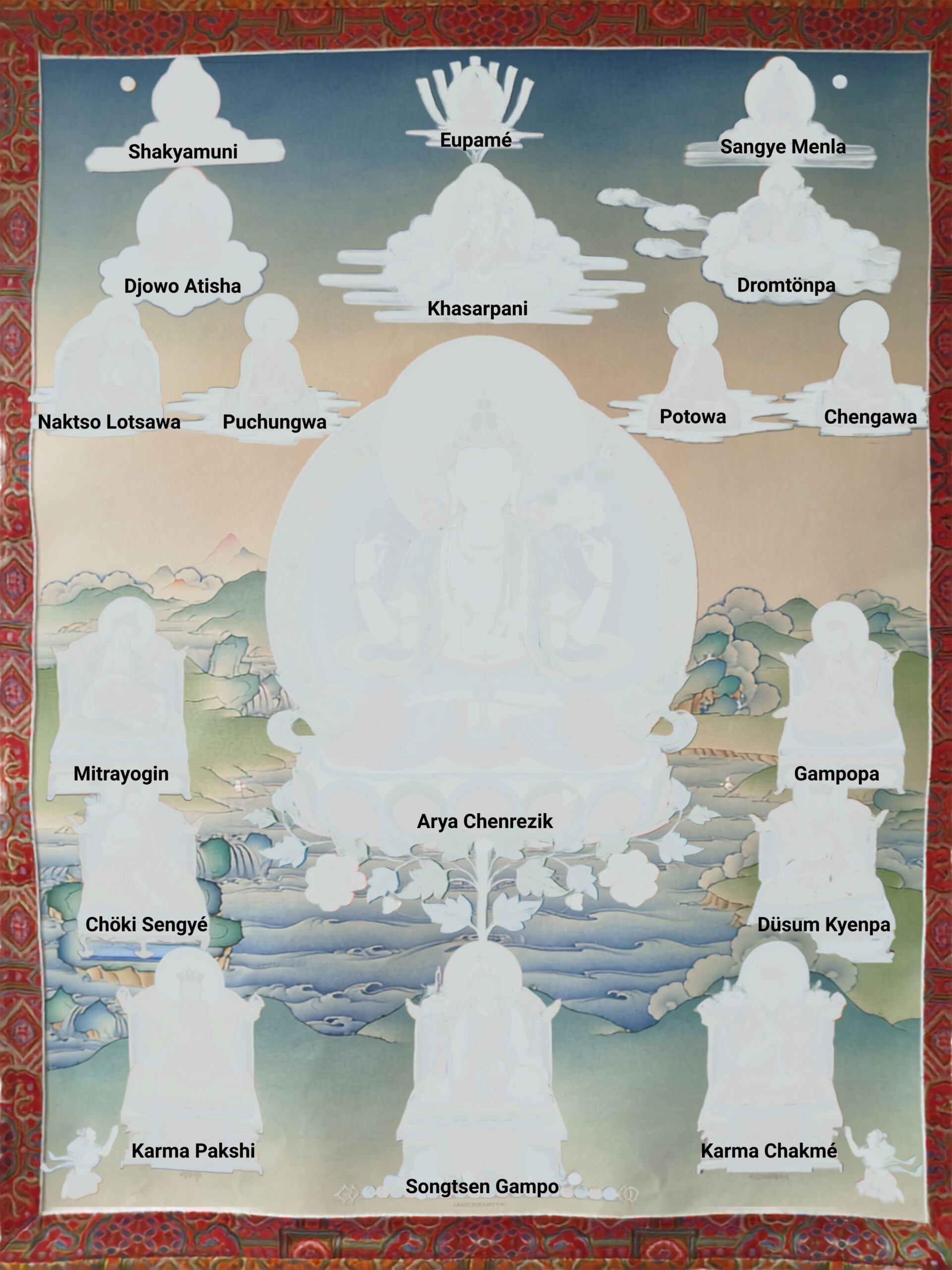
At the centre, above Noble Four-Armed Chenrezig (Skt. Avalokiteśvara), sits Khasarpani (ཁ་སར་པའ་ཎི་), a form of Chenrezik depicted in the royal ease posture, with his right hand in the gesture of generosity and his left holding a lotus flower. Above him is Amitabha Buddha (Tib. Öpame, འོད་དཔག་མེད་). Beneath this awakened presence sits Songtsen Gampo (c. 605–650), the first Buddhist king of Tibet, who is himself regarded as an emanation of Chenrezig.
The vertical line on the left forms a first transmission lineage while remaining connected to the one on the right. Beneath Buddha Shakyamuni sits the Indian master Atisha (982–1054), who received teachings directly from his four yidams: Buddha Shakyamuni, Tara, Chenrezig, and Manjushri.
Atisha, who played a pivotal role in the second dissemination of Buddhism in Tibet, transmitted these teachings to his principal disciple, Naktso Lotsawa (1011–1064 ག་འཚོ་ལོ་ཙཱ་བ), when the latter was already advanced in age. Naktso Lotsawa in turn transmitted the teachings to three disciples known as the “Three Brothers,” depicted alongside him from left to right: Puchungwa Shönu Gyaltsen (1031–1106 ཕུ་ཆུང་བ་གཞོན་ནུ་རྒྱལ་མཚན་), Potowa Rinchen Sal (1027–1105 པོ་ཏོ་བ་རིན་ཆེན་གསལ་), and Chenga Tsültrim Bar (1038–1103 སྤྱན་སྔ་ཚུལ་ཁྲིམས་འབར་).
Below Naktso Lotsawa appear the mahasiddha Mitrayogin (dates unknown མི་ཏྲ་ཛོ་ཀི་), the Kadampa master Chapa Chöki Sengyé (1109–1169 ཕྱྭ་པ་ཆོས་ཀྱི་སེང་གེ་), and the Second Karmapa, Karma Pakshi (1204–1283 ཀརྨ་པཀྵི་).
A second transmission lineage unfolds on the right. At its summit is the Medicine Buddha, Sangye Menla, and below him Dromtön Gyalwa Jungné, known as Dromtönpa (1005–1064 འབྲོམ་སྟོན་རྒྱལ་བའི་འབྱུང་གནས་), Atisha’s lay disciple.
Dromtönpa, having contracted leprosy from those afflicted with the disease to whom he taught, is said to have healed himself through the practice of Medicine Buddha. Like Naktso Lotsawa, Dromtönpa also counted the Three Brothers among his disciples. Their principal disciple was Gampopa Sönam Rinchen (1079–1153 སྒམ་པོ་པ་བསོད་ནམས་རིན་ཆེན་), who transmitted the teachings to Düsum Khyenpa (1110–1193 དུས་གསུམ་མཁྱེན་པ་), the First Karmapa.
Finally, Sherab Gyaltsen Rinpoche advised that one last figure be included: Karma Chakmé (1613–1678 ཀརྨ་ཆགས་མེད་), author of the Amitabha Prayer and numerous writings on Chenrezig.
Let us sit for a moment in the quiet of the reading room, facing this thangka. Let us take the time to rest our gaze on each of the figures depicted.
Do we know these practitioners? The story of their liberation? Who are they for us, apprentice practitioners of the twenty-first century? A distant, linear hierarchy removed from our reality?
We often speak of lineage and transmission in our Buddhist lives, but do we truly appreciate the depth of what these words encompass?
The French word transmettre (to transmit) derives from the Latin trans, meaning “beyond,” and mittere, meaning “to send.” To entrust, to send beyond oneself. Is transmission really a fixed and linear spiritual inheritance, or is it better understood as an ongoing and dynamic process without a true endpoint?
What inspired such a profound interest in these practitioners that they sought out a teacher, listened to their words, and put them into practice with complete confidence until the teachings became like a second skin? And why, in turn, did they entrust these words, methods, and understandings to others beyond themselves?
Perhaps taking the time to become familiar with these practitioners of the past can dissolve the distances of time, culture, and geography, and foster a more intimate and living relationship with the practice itself.