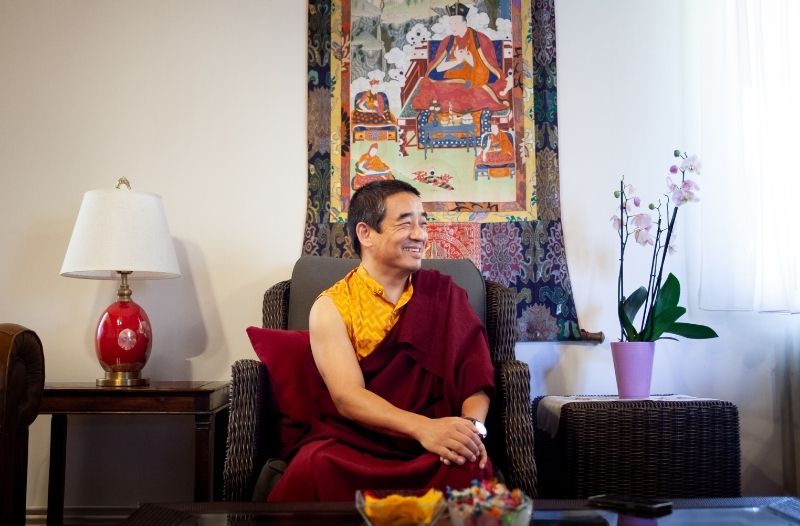
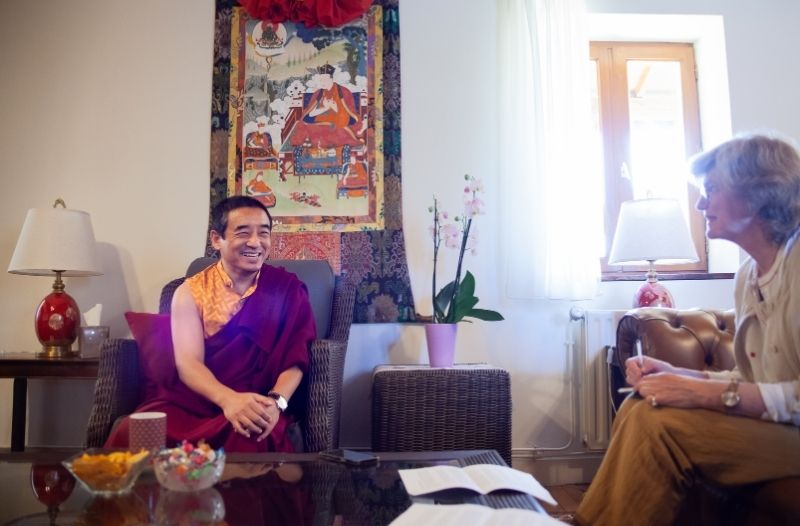
During the month of May 2026, Dhongtsang Shabdrung Rinpoche gave a four-day teaching on The Treatise Entitled Revealing the Essence of the Tathagata at Dhagpo Kagyu Ling. Based in Siliguri, West Bengal, India, Dhongtsang Shabdrung Rinpoche is among the eminent teachers who have been sharing the Dharma at Dhagpo for many years. In the continued commemoration of our fiftieth anniversary, we spent some time with him during his stay to find out more about his life and activity.
I always have in mind that
I’m teaching for those who are listening.
It was in 2007. I was on my way to my monastery in Yushu, Tibet. I was staying at a Karma Kagyu centre in Hong Kong applying for my visa when I received a phone call from Shamar Rinpoche asking me what I was doing. He told me that it is good that I go to my monastery and that I should come back soon. I asked if there was anything that I should be doing. He said that I have to go to Europe. Of course I said yes.
I went to Tibet and upon my return, Shamar Rinpoche told me that I should replace him for his program as he couldn’t come. This was my first time in Europe. That’s how I came, first to Renchen Ulm, then to Dhagpo.
What is your connection with the 16th Karmapa, Kunzig Shamarpa and Jigme Rinpoche?
For the 16th Karmapa, it’s more linked with my previous life.
I met Jigme Rinpoche for the first time in Kalimpong when I was staying at Shamar Rinpoche’s house, around 2005. Then I met him again in Dhagpo when Shamar Rinpoche sent me here for the first time.
I met Shamar Rinpoche when I was very young, living in the Ngor monastery in Dehradun where I was mainly learning ritual aspects. My teachers used to bring me to see Shamar Rinpoche because in my previous life I was in the Athup tsang, in Jigme Rinpoche and Shamar Rinpoche’s family. They thought that’s where I belonged. Shamar Rinpoche gave me guidance and support. When one is recognized as a young tulku, there should be an enthronement ceremony that usually involves inviting Rinpoches and giving offerings to all the monks etc. This ceremony was held during a big empowerment given by Sakya Trichen. Shamar Rinpoche covered all the expenses.
You studied at Dzongsar Institute, where you graduated from in 2005. Did you have a particular field of specialization?
 At the time, it was quite difficult to get admission into the shedra [1] as financially it was weak and there was a lack of accommodation. So there was kind of a lottery system to get in as there were not enough places for so many students applying.
I was actually the youngest one studying there and was selected by Dzongsar Jamyang Khyentse Rinpoche so I didn’t have to go through this. There were no specializations. Every year we studied two different subjects. For example in first year, the Bodhicharyavatara and Sutralankara; in the second year it was Madhyamaka based on the root text and commentaries, in the third year epistemology (tsema), in the fourth year the Abhidharma, in the fifth year the Prajnaparamita, the sixth year the Vinaya, and so on. So each year there was a different subject.
And then you went to University of Berkeley, in California. That must have been quite a contrast with your traditional education!
First, after finishing the shedra, I told Shamar Rinpoche that I would like to stay in retreat, so I stayed at his house in Kalimpong for a three-month retreat, mainly about Amitayus. After that, Rinpoche asked me to teach at the Kalimpong shedra.
Then I travelled a little in Asia, when Sakya Trichen and Luding Khen Rinpoche asked me to look after a monastery in Gangtok, Sikkim. Then, through the Khyentse Foundation, I became an exchange scholar at UC Berkeley, in the Asian studies program, for one semester. They arranged two guest lectures and other than that,
I was able to join any class that interested me—physics, neuroscience, language classes. I joined a translation conference on the Guyasamaja tantra and also helped a few PhD students in Buddhist philosophy with their theses.
It’s interesting how you often begin your teachings on very profound topics like Buddha nature by showing their relevance to our daily lives. Did your exposure to Western students lead you to introduce subjects in this way?
 I think it also depends on who is studying. If the audience is really trying to study Dharma more profoundly, I think it’s really helpful to understand the words. Because each word can have very different meanings.
That’s why I’ve been trying to go slower with Namshe Yeshe last year, and now with The Treatise Entitled Revealing the Essence of the Tathagata that we just started this year. Before this, I wasn’t going word by word. Again, it depends on the audience, but most of the time, many people come to have some general idea, about Abhidharma for example, so we go through the main meaning rather than the more profound word by word. They might get bored otherwise!
Also, whether in the West or the East, when you study something, most of the time you think you know it. But in fact, you don’t really know! It’s the case in our shedra also. For example there are different ways of explaining the five aggregates according to different schools and different texts.
So there are so many things to learn.
You are responsible for a monastery in Yushu, Tibet, established by your predecessor. Could you tell us about your activity there?
 I went to Tibet around 1995 with my late father.
At the time, the circumstances were very poor. I stayed there for almost six months doing a retreat and giving mainly empowerments in different regions as I was very young.
The main temple, which was built by my predecessor, the third Dhongtsang Shabrung Rinpoche, the elder brother of the 16th Karmapa, was destroyed in the late 1950s. There were just some remains left.
We were planning to rebuild that temple. My late father travelled around different regions where I had relatives to get permission to take the wood from the forest to rebuild the monastery. We appointed one of my monks to take charge of it as I didn’t have permission to stay more than six months and had to return to India for my studies. So the temple was rebuilt. Then we had plans for building a bigger shedra as at the time we only had a few rooms above another small temple nearby.
For many years, it was just a plan. After the earthquake in Yushu in 2010, a few followers from the monastery made offerings to rebuild the main temple that had been damaged as well as the smaller one with the shedra.
I think the Chinese government also gave support for compensation. So with these funds from different sources, we were able to build the shedra. It counts some 200 to 300 monks and is going well. There’s also a big drupkang, a retreat center with some 300 or 400 people that is mixed; there are lay practitioners, nuns and monks.
Personally, I haven’t been able to return there since 2010 due to difficulties in getting the visa.
As you know Dhagpo celebrated its fiftieth anniversary last year, and we are very fortunate that you have been coming here for many years now. What do you see as Dhagpo’s value in preserving and spreading the Dharma in Europe?
It’s very rare to see a place trying to preserve the authenticity of the Dharma. Because in most places, they are trying to spread the Dharma, but not really a fundamental and authentic Dharma. It’s more based on people’s interest. But what I see in Dhagpo, with Jigme Rinpoche’s guidance, is that it’s trying to preserve the real value and authenticity of the Dharma. I think this is the one thing that you see that is very rare nowadays.
[1] Buddhist place of higher learning offering a full program of Buddhist philosophical studies.